
|
|
 |
|
|
Pruning
Welcome to Old Garden Tools collection of Pruning Tools. We have laid our images out in museum style so that you may concentrate just on the images without any other distractions. Just hover over the image or click on it to see a larger version with some additional information.
Please contact us if you require further information.
 Axe A
Axe A
Steel blade stamped ‘Brades Co. No 2’. Oak handle. 15.7 inches (49.7cms).
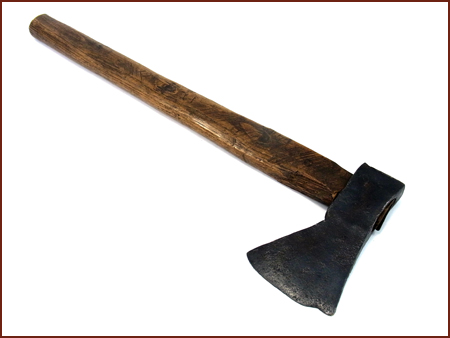 Axe B
Axe B
C 1900. Steel blade stamped ‘1000’. Oak handle. 21 inches (53.5cms).
 Axe C
Axe C
French. 20C. 17.5 inches (44.5cms).
 Axe D
Axe D
English. 20C. Mini Axe with ash handle. Steel head stamped ’11’. 7.75 inches (19,7cms).
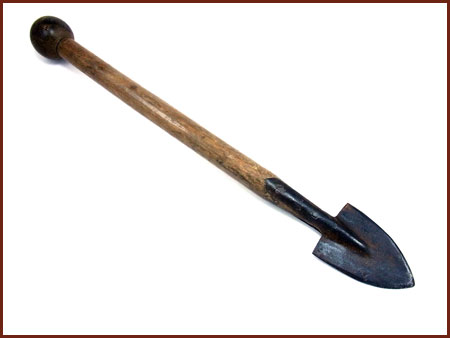 Barking Iron B
English. Heart shaped strapped blade stamped ‘191’. ‘? Lucas’. Ash shaft with pegged wooden ball grip. 29.75 inches (75.5cms).
 Barking Iron C
English. Late 19C. Wrought iron spatulate design and ash with T-handle. 37.7 inches (95.7cms).
 Barking Iron D
Wrought socket with small circular head. Ash T-handle. 11.5 inches (29.3cms).
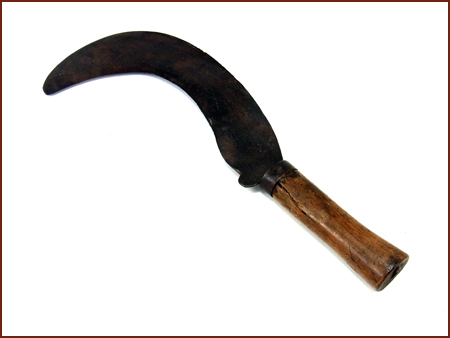 Bill Hook A
Stamped ‘T(?) Helson. Dunsford’ on tanged blade. 17.25 inches (44cms).
 Bill Hook AA
English. Early 20C. Hooked steel blade mounted in beech wood handle with 2 rivets. Blade stamped ‘S’ logo and ‘C T Skelton. Sheffield. England’. 7.2 inches (18cms).
 Bill Hook AB
French. Mid 20C. Simple steel blade set into beech handle with 1 fixing nail. 7.5 inches (19cms).
 Bill Hook AC
French. Early 20C. Steel blade and wooden handle. For vine use pruning grapes and cutting string. 5.6 inches (14.3cms).
 Bill Hook AD
French. Early 20C. Hooked tanged steel blade stamped ‘Mutel. A Damra*’. Ash handle and brass ferrule. 6.8 inches (17.5cms).
 Bill Hook AE
French. Early 20C. Steel tanged blade with cutting edge on back stamped ‘Crown logo and G.S’. Turned beech handle with knop and brass ferrule. 9.6 inches (24.3cms).
 Bill Hook AF
French C1900. Hooked tanged steel blade stamped ‘Burdigala’. Beech handle steel ferrule. 8.3 inches (21cms).
 Bill Hook AG
English. Early 20C. Steel with ash handle. Stamped ‘J Harrison Warranted’ with JH Logo. 14.3 inches (37.5cms).
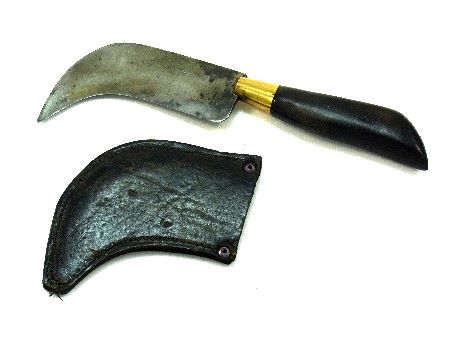 Bill Hook AH
French. Circa 1900. Fine gentlemans pocket Bill Hook with leather sheath. Tanged steel blade stamped ‘Bost Freres. Nogent’ and polished horn handle. 8.75 inches (22cms).
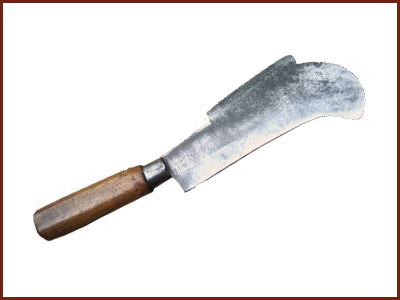 Bill hook B
English. 20C. Stamped ‘WHS’ on blade. Beech handle with tang. 14.75 inches (37.5cms).
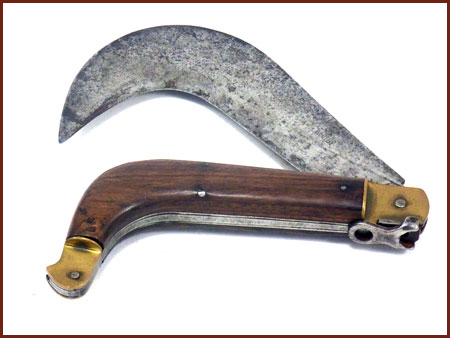 Bill hook C
English C1900. The Whitby. Made in Italy. Folding Billhook with rosewood and brass handle. This and the sister Folding Pruning Saw were supplied in a cardboard presentation box marked ‘Whitby’ on the lid and inside, ‘The Whitby folding pocket bill hook and pruning saw’. Open 12.3 inches (31.5cms) x Closed 6.7 inches (17cms).
 Bill Hook D
Steel blade and ferrule. Beech handle. 10.25 inches (26cms).
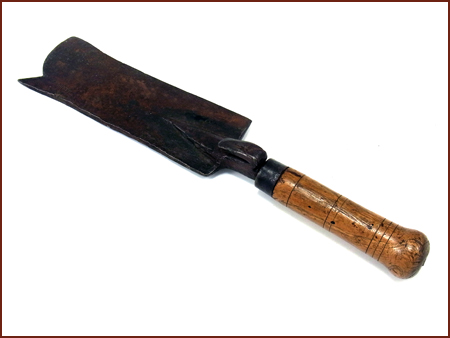 Bill Hook E
French. Early 20C. With belt hook. Steel tanged blade stamped ‘J Dupupet’ 15.5 inches (39.5cms) x 2.75 inches (7cms).
Please contact us if you require further information.

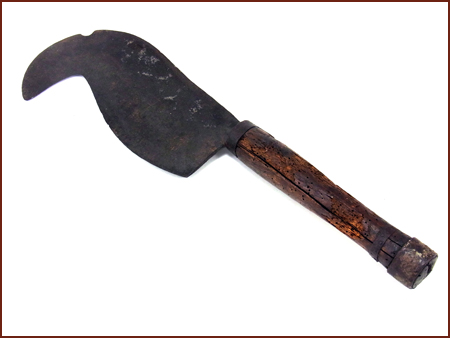 Bill Hook F
French. C1900. Steel blade with sharply curved pointed and notched nose. Stamped ‘L.T’ on back edge. Ferrules at ends of handle nailed to wood. 18 inches (45.5cms).
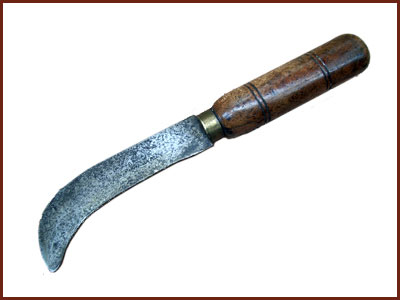 Bill Hook G
English. Early 20C. Beech handle. Brass ferrule. Steel blade stamped ‘Brodie. Hornsey Road’. 9.5 inches (24cms).
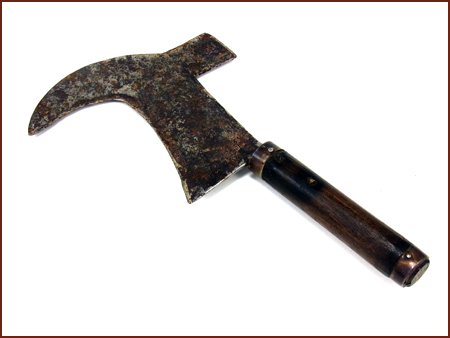 Bill Hook H
Steel blade stamped ‘A H’ on raised back edge with beech handle in 2 halves secured by a ferrule at each end and twin rivets. 14.5 inches (37cms) x 8.25 inches (21cms).
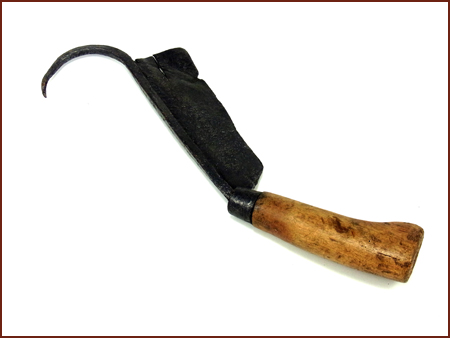 Bill Hook I
Blade forged to hook. Fruitwood handle with steel ferrule. 15.5 inches (39.2cms).
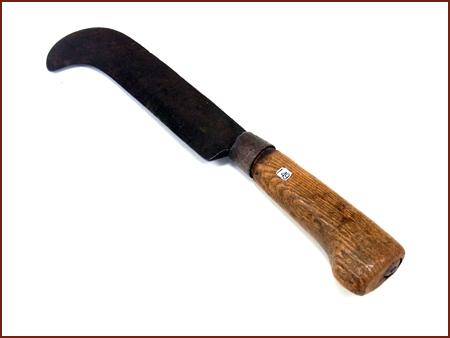 Bill Hook J
English. 20C. Steel blade stamped ‘Elwell 29 2-7’. Ash handle with tang and washer. 12.75 inches (32.5cms).
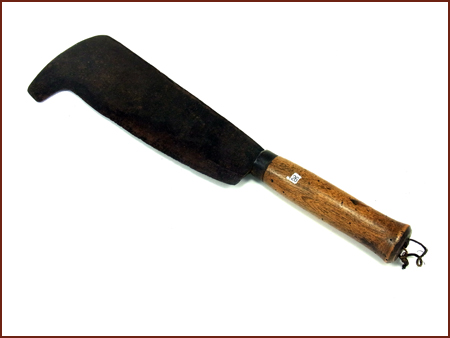 Bill Hook K
English. 20C. Steel blade tanged with suspension string. Stamped ‘Finch Bros’. 16.5 inches (42cms).
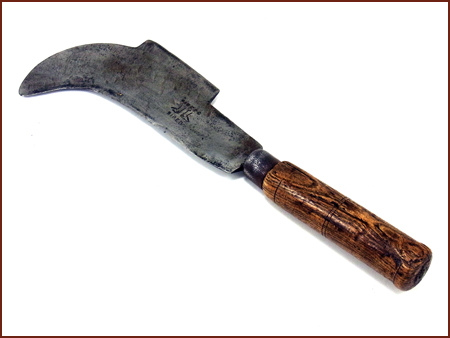 Bill Hook L
English. 20C. Tanged steel blade stamped ‘Parkes Biped’ with feet logo. Ash handle. 14.25 inches (36cms).
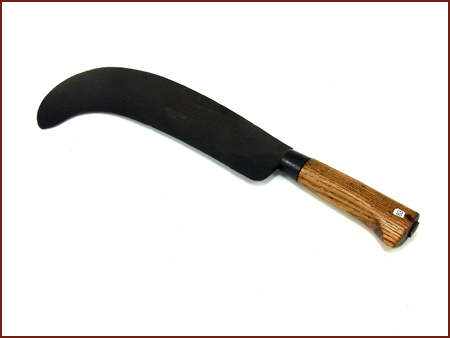 Bill Hook M
English. 20C. Blade fixed with tang and nut. Stamped ‘Brades Co. 185’. Ash handle. 16.25 inches (41.5cms).
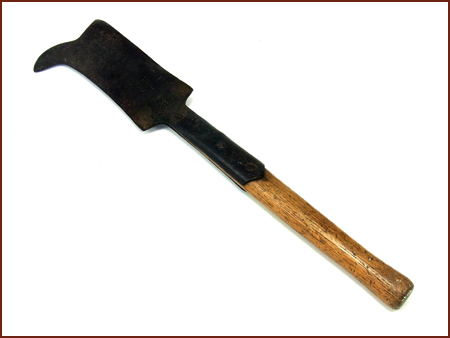 Bill Hook N
English 20C. Yorkshire Billhook. Steel blade stamped ‘Elwell 3807 3’. Ash handle. Riveted to socket. 23.25 inches (59.5cms).
 Bill Hook O
C 1900. Wrought tanged steel blade with washer. Dark ash handle. 18.3 inches (46.7cms).
 Bill Hook P
French. Bird motif. Curved steel blade embossed ’43 Bourdier’. Marcel Bourdier was a cutler who registered the trademark ’43 Bourdier’ in 1879. This is a trademark of the cutlery of Thiers 1809 to 1980. 8 inches (26.6cms) x 2.75 inches (7cms).
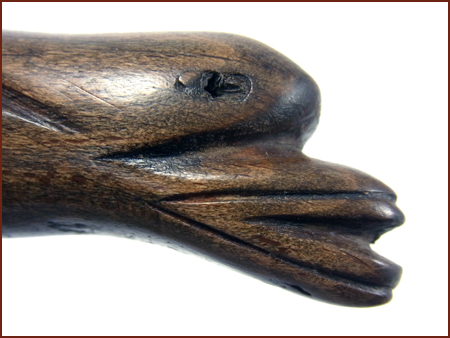
 Bill Hook Q
English Mid 20C. Elwell. Tang and washer. Traces black paint on steel blade stamped ‘Elwell’. 15.75 inches (40cms).
 Bill Hook R
English. C1850. Steel blade and cross hatched design bone handle. Stamped on blade ‘Joseph Rodgers & Sons. Cutlers to his majesty. *Star. Maltese cross’. 8.25 i nches (20.8cms) x 1.5 inches (4cms).
 Bill Hook S
English. 20C. Blade with hooked and pointed nose curving towards back. Blade stamped ‘Brades. Pat Tn-211 9 in’. Ash handle with carved initials ‘P.H’.17.5 inches (44.5cms). Blade 9 inches.
 Bill Hook T
french. 20C. Tanged blade has pointed sharply curved nose stamped ‘Despois A7’ & logo. Fruitwood handle. 16.5 inches (42cms).
 Bill Hook U
English. 20C. Stamped on back edge of tanged and washered blade ‘Parkes Biped1532’ Stainless steel ferrule. Ash handle. 13.75 inches (35cms).
 Bill Hook V
English. 20C. Blade tanged and washered. Stamped ‘USS*LE Improved’. Ash handle. 15 inches (38cms).
 Bill Hook W
English. C 1880. Stag antler scales riveted to steel blade. Stamped ‘Milton Hatchett’ and ‘Sheffield’. Missing leather sheath. 11.5 inches (29.3cms).
 Bill Hook X
Steel blade and stained beech handle. Steel ferrule. 13.25 inches (33.5cms).
 Bill Hook Y
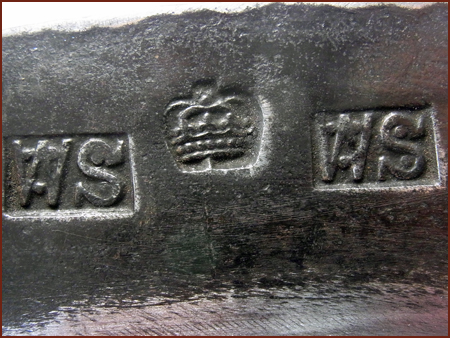
English. 20C. William Swift ash handle in socketed blade with hooked nose for catching branches. Stamped ‘WS crown logo WS’. 1 rivet. 19.7 inches (50cms).
 Bill Hook Z
French. 19C. Steel blade stamped ‘Neplaz a Alais 3’. Apple wood handle. Brass ferrule. 10.5 inches (26.6cms).
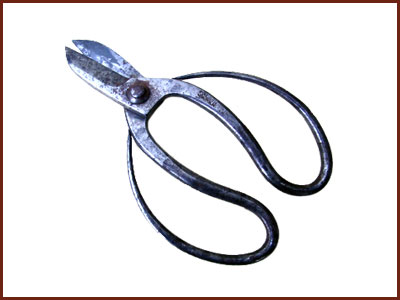 Bonsai Scissors A
Japanese. 20C. Steel scissor with finger guards stamped ‘Made in Japan’ and with Japanese characters. 6.6 inches (17cms) x 4 inches (10.3cms). ‘Tokyo Yoshi Masu Special’
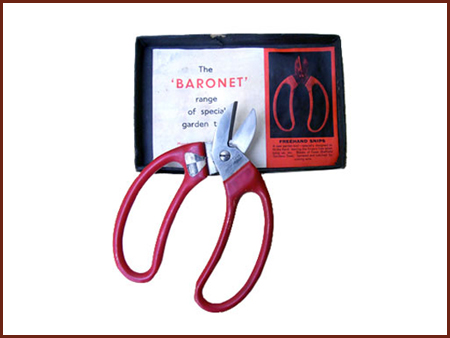 Bonsai Scissors C
English. Late 20C. The ‘Baronet’ Freehand Snips. A Wright & Sons Ltd Sheffield. Design Centre sticker. Serrated and notched blades for string and wire cutting. Red rubberised grip. Box. 6.75 inches (16.75cms) x 4.75 inches (12cms). Snips 6.5 inches (16.5cms).
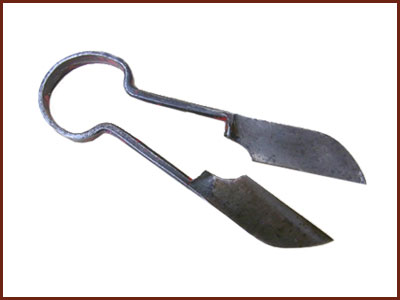 Bonsai Scissors D
Small steel snips with traces red paint. 4 inches (10.2cms).
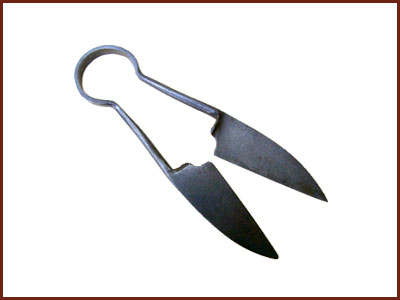 Bonsai Scissors E
Forged steel snips. 5.2 inches (13cms).
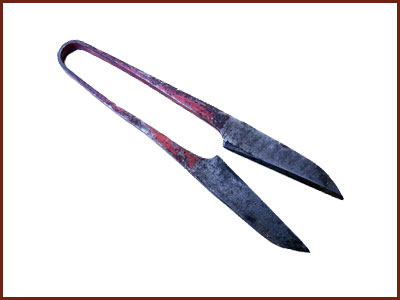 Bonsai Scissors F
Small slender steel snips with traces red paint. Stamped ‘Foreign’. 4.3 inches (11cms).
 Bonsai Scissors I
Forged steel scissor with finger guards in leather sheath which is stamped ‘Happy Sack’. 6.5 inches (16.5cms).
 Folding Saw Z
Italian. Early 20C. Made in Italy and sold in England. A sister tool to the Bill Hook C featured here. Closed 9.5 inches 24cms.
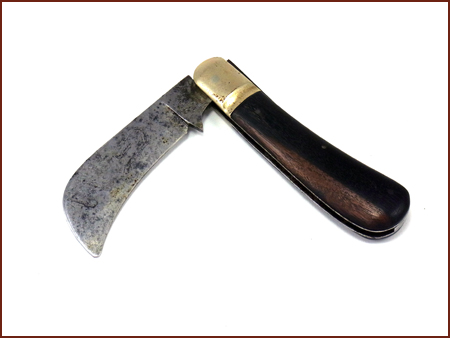 Folding Knife A
English. Lignum Vitae scales. Brass ferrule. Stamped ‘Witness. Sheffield. England’ plus Logo. Open 7.7 inches (19.4 cms) x Closed 4.5 inches (11.5cms).
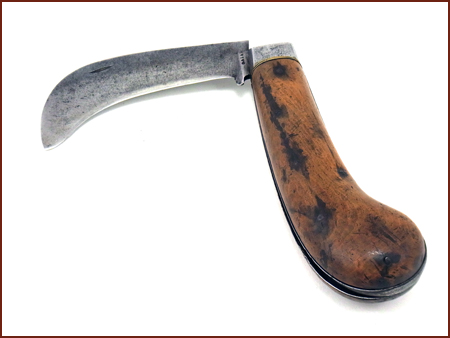 Folding Knife C
Fruitwood scales. Brass base plate. 2 stage locking mechanism. Open 9.8 inches (25.2 cms) x Closed 5.75 inches (15cms).
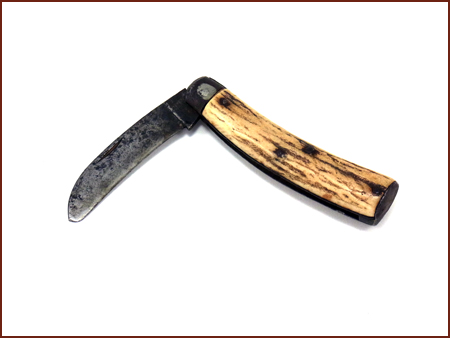 Folding Knife D
English. C1900. Staghorn scales. Stamped on base of blade ‘Saynor Cooke Ridal and Obtain’ and along face of blade ‘Saynor’. Open 7 inches (18cms). Closed 4.3 inches (10.5cms).
 Folding Knife E
20C. Mahogany scales. Open 6.2 inches (15.5cms) x Closed 3.5 inches (9cms).
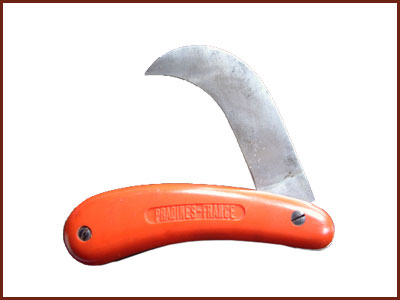 Folding Knife F
French. 20C. Folding Pruning Knife with steel blade and casement and orange bakelite scales. 2 screws. Stamped ‘Pradines France No. 20 – 11 cm. ‘Pradines’ was a trademark from 1865 when secateur production was started. in 1934 Roger Deville bought the trademark. in 1959 the company of 35 employees leaves Les Mureaux Paris and set up in Bauge, Maine et Loire. Closed 4.25 inches (11cms) x Open 7.25 inches (18.5cms).
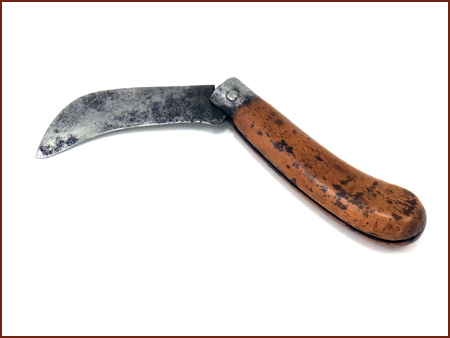 Folding Knife G
French. 20C. By Remont. Sycamore and steel. 5 inched folded (12cms).
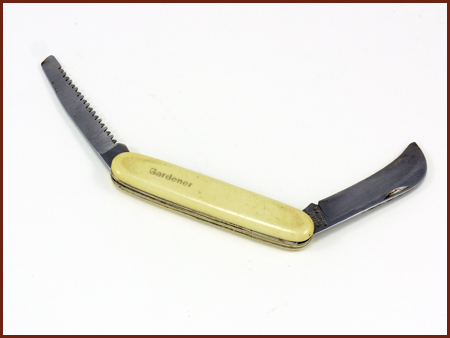 Folding Knife J
English. Saw blade and cutting blade. ‘The Gardener’. Stamped ‘I*XL and logo with ‘Rodgers. Stainless. Sheffield. England’. Open 8.6 inches (21.8cms) x Closed 3.7 inches (9.4cms).
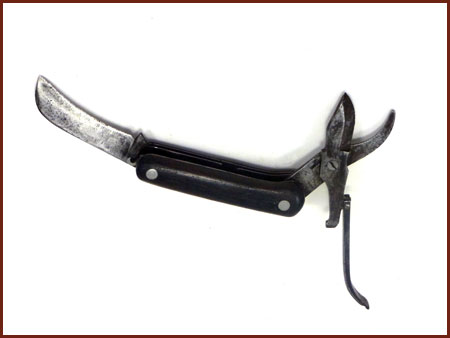 Folding Knife K
English/German. Made in England 1950. This multi-tool was made in England by Ibberson for Hoffritz (Hoffritz is the merchant brand). More than one factory manufactured multi-tools for Hoffritz and some examples are marked “Made in Germany”. It contains folding shears and a pruning blade. Stamped ‘Trade ## Double Sharp’ Open 9.7 inches (24.7cms) x Closed 3.8 inches (9.8cms). Some also contain a saw. Similar multi-tools were sold by Luna, Bonsa, Voss Cut Co, and Edward Zinn. They were manufactured until the 1950’s.
Please contact us if you require further information.
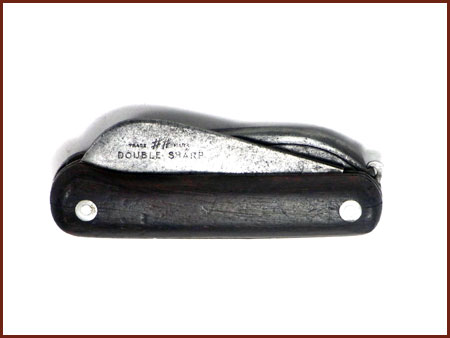
 Folding Knife L
French. Early 20C. Stamped ‘Trente Deux. 32. Dumar Aime’. Steel blade with thumb lever within solid beech handle. Open 6.9 inches (17.6cms) x Closed 4.75 inches (12.1cms).
 Folding Knife M
French. 20C. Solid grooved sycamore handle with steel grooved ferrule. Steel blade stamped with double anchor trademark. Open 8 inches (20.4cms) x Closed 4.6 inches (11.6cms).
 Folding Knife N
French 20C. Bird motif. Steel blade with very fine saw edge. Solid mahogany handle steel blade stop. Open 10.6 inches (27cms) x Closed 6.4 inches (16cms).
 Folding Knife O
English. C 1931. Steel with 2 blades and stag horn scales. Pruning blade and secateurs with hanging band. Stamped ‘England’ with English cross logo and indistinctly ‘*****sons’. A similar 3 bladed tool complete with tweezers was sold by Holtzappfel and was illustrated in the 1931 catalogue as The ‘Handy’ Gardeners Knife. Open 8 inches (20cms) x Closed 4.7 inches (12.3cms).
 Folding Knife P
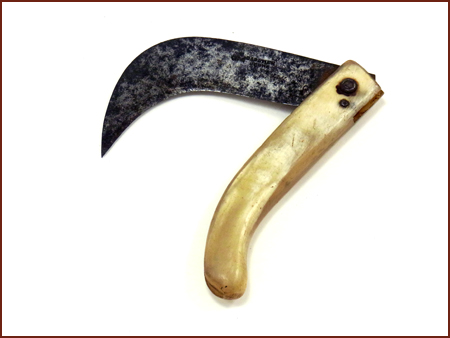
French. C1900. Steel and solid cow horn handle. . Stamped ‘Sabatier Jeune with crown on K logo’. Open 7.5 inches (19cms). Closed 4.3 inches (11cms).
 Folding Knife Q
French. 19C. Folding Billhook with stag horn handle and sprung steel blade. Imprint on blade indecipherable but maker recognised as Roux at Bourg Achard France. Open 9.7 inches (24.5cms).
 Folding Knife R
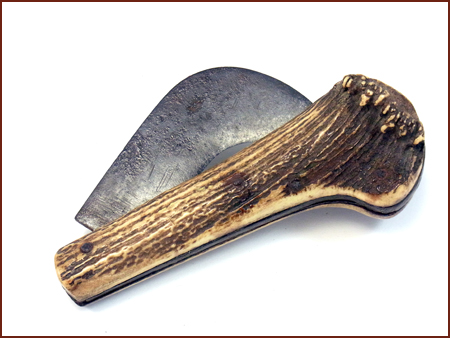
French. C1900. Folding Bill Hook. Pitted steel folding blade stamped ‘Cha*mett Acc**’. Fruitwood handle. Open 8.5 inches (21.5cms). Closed 5.2 inches (12.8cms).
 Folding Knife V
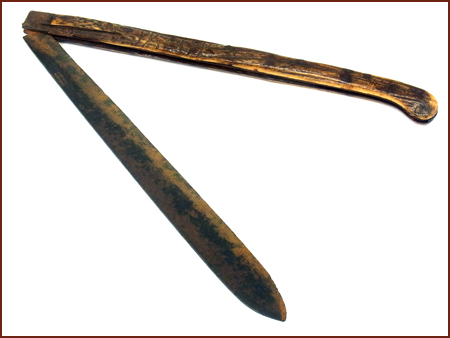
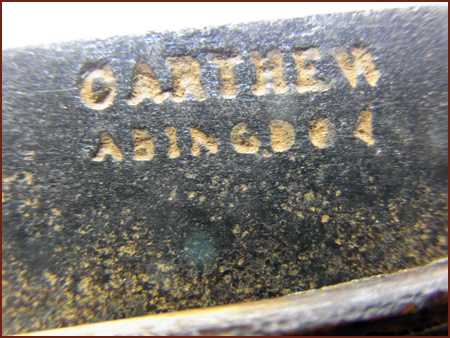
English. C1800. Long Folding Pruning Knife with steel blade and stag horn scales. Carved initials on one scale ‘YYic+YY’. Blade stamped ‘Carthew. Abingdon’. Long blade counter spring is decorated with bands of cross lining. Closed 13 inches (33cms) open 25 inches (64cms).

 Folding Knife W
English. 20C. Folding Knife stamped on stainless steel mechanism ‘Stainless’. Mahogany scales. Hanging loop. Closed L 4 inches (10cms).
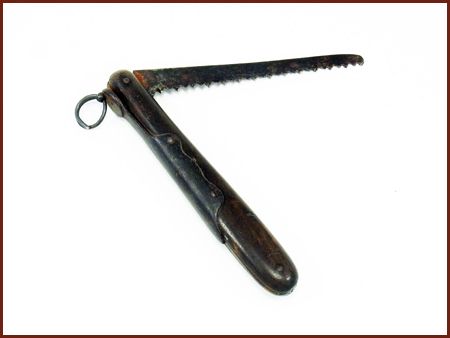 Folding Saw A
English. C1900. Hardwood handle with ornate 2 position spring lock. Hanging eye. Tapered toothed blade with nail grip at tip. Stamped ‘*B.L.F & Co’. Open 11.5 inches (25.9cms). Closed 6.5 inches (16.3cms).
 Folding Saw B
English. C1950. Folding lockable Pruning Saw with steel locking spring. Stamped ‘W A Tyzack & Co Ltd. Sheffield’. Ref CGA. 1953 ‘Pocket Folding Pruning Saw’. Open 14 inches (35.5cms). Closed 8 inches (20.2cms).
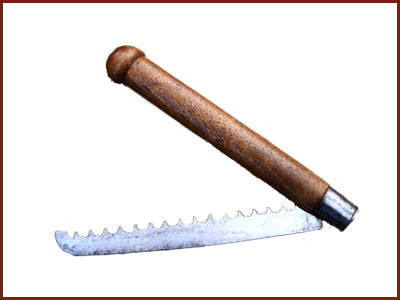 Folding Saw C
French. 20C. Steel and beech. Double toothed blade and turn lock ferrule. Stamped ‘Etoile St Etienne & Star MF logo’. Open 13.8 inches (35.3cms). Closed 7.5 inches (19cms).
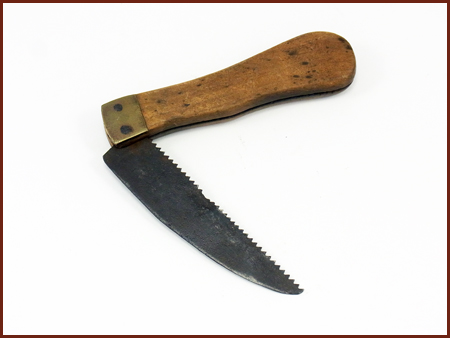 Folding Saw E
Steel and wood with brass clad hinge. Open 8.5 inches (21.5cms). Closed 4.8 inches (10.9cms).
 Folding Saw F
French. Early 20C. Steel and boxwood. Non locking ferrule. Open 15 inches (38cms). Closed 8 inches (20.5cms).
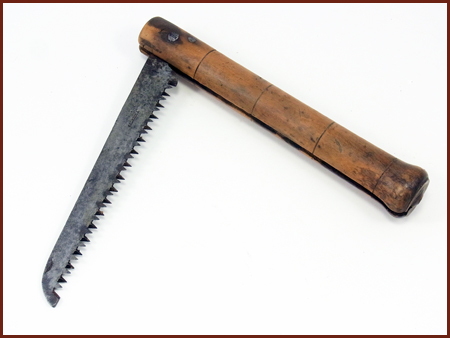 Folding Saw H
French. Early 20C. Fruitwood handle. Double toothed steel blade with thumbnail pull at tip. Stamped ‘Saladin’. Open 15 inches (38cms). Closed 8.25 inches (21cms).
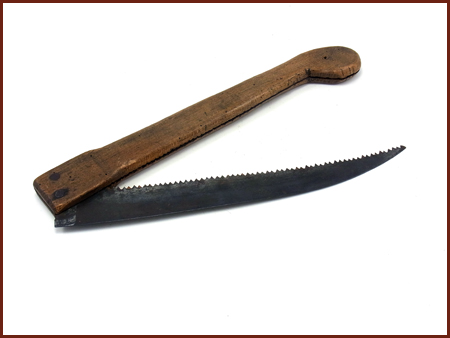 Folding Saw J
Open 28.5 inches (72cms).Sub-image from ‘Gardening Complete Guide’ by Ward Locke 1890.
Please contact us if you require further information.

 Folding Saw L
Steel blade with brass locking press stud to open and 2 holes in base of blade to lock closed and open. Plywood handle. Open 21 inches (53cms) Closed 12.5 inches (31.5cms).
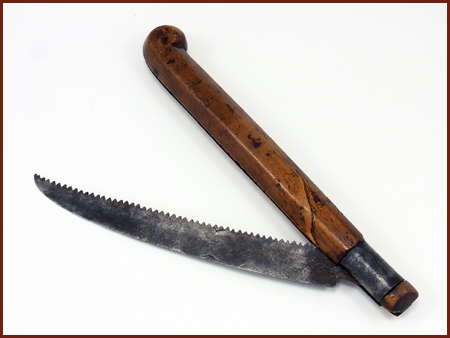 Folding Saw M
French. 19C. Turnlock feature. Hardwood handle. Floral motif. Open 17 inches (43cms). Closed 9.5 inches (24.3cms).
Please contact us if you require further information.

 Folding Saw N
English. 1930’s. Rolcut. Ref: Bentleys catalogue 1939 ‘The Rolcut Saw No. 11’. Ref: Rice Bros Ltd. Garden Catalogue. Beech handle with tapered steel double toothed blade, brass clip and steel lever nut. Handle stamped ‘L W Edmunds’ Blade stamped ‘Rolcut. Sheffield. England’. Open 21.5 inches (55cms). Closed 11.5 inches (29cms).
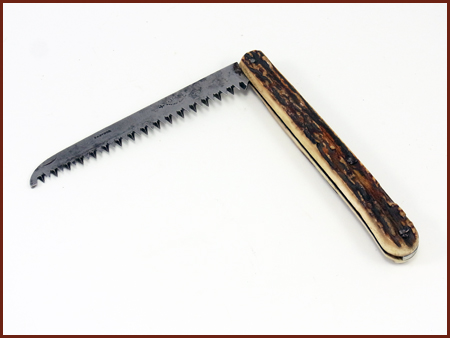 Folding Saw O
French. C1900. Double toothed steel blade and antler handle scales. Nail grip on tip of blade. Stamped ‘Brevette. Saladin. F & St Antoin** + cruciform logo’. Open 12 inches (33cms). Closed 6.3 inches (16.2cms).
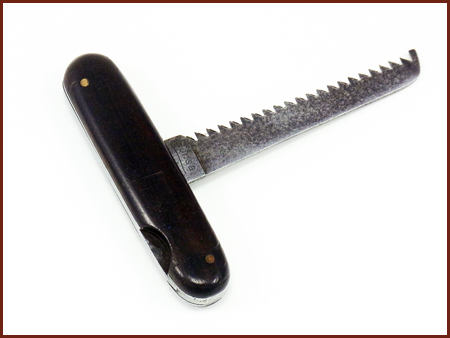 Folding Saw P
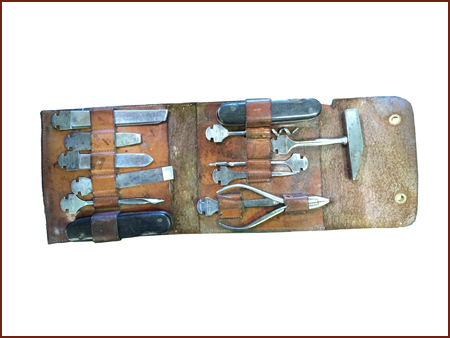
German. early 20C. Blade stamped ‘Bonza’ the trademark. Blade 4 inch (10cms). Made by Boentegen & Sabin. Germany (1867 – 1983). Rosewood with 2 position detachable blade. Lever lock is spring actuated (see small cutout on handle). Could be supplied by U J Ulery Co. NY. as 6 part pocket knife tool kit in leather pouch for 2.25$ in 1905. A 12 part compendium in a leather pouch was also available – pictured. The saw and knife blades in the compendiums were sheathed in a stainless steel cover engraved with measuring scale. 4.5 inches (11.5cms) x 3.75 inches (9.5cms).

 Folding Saw Q
German. early 20C. Rosewood with 2 position detachable blade stamped ‘Bonza’ the trademark 7 inch (17cms) stamped Bonza’ the trademark and on the reverse ‘Bonanza’. . Made by Boentegen & Sabin. Germany (1867 – 1983). Could be supplied by U J Ulery Co. NY. as 6 part pocket knife tool kit in leather pouch for 2.25$ in 1905.. Blade lock here is lever actuated. A 12 part compendium in a leather pouch was also available – pictured. The saw and knife blades in the compendiums were sheathed in a stainless steel cover engraved with measuring scale. L 7.5 inches (18.5cms) x W 3.75 inches (9.5cms).

 Folding Saw R
French. Early 20C. Steel and fruitwood. Stamped ‘Cross Clubs logo + Tremre*. Peugeot Freres. Open 10.3 inches (25.8cms). Closed 5.5 inches (14cms).
 Folding Saw S
French. C1900. Steel and beech. Open 11.3 inches (29cms). Closed 6 inches (15cms).
 Folding Saw T
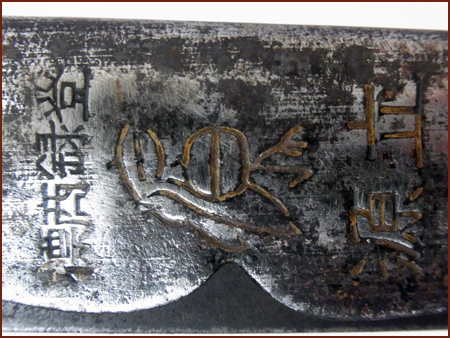
Chinese. 19C. 3 bladed Folding Knife with billhook blade and 2 saw blades. Chinese characters on handle and hook blade. We would love an interpretation. L closed 10.5 inches (26.5cms) L open 18.5 inches (46.5cms).

 Folding Saw U
Late 19C. Stag antler scales with on one side an inlaid polished steel linear plaque (un-engraved), Steel folding saw, 2 knives, lifter and ivory grafting leaf. Open 13.5 inches (34.3cms). Closed 5.75 inches (14.8cms).
 Folding Saw V
English. C1900. Boxwood scales and folding steel saw blade with locking mechanism. Stamped ‘Thornhill. VcrownR’. Open 11.75 inches (32.7cms). Closed 7.25 inches (18.5cms).
 Folding Saw W
French. C1900. Steel toothed blade for cutting on the pull and beech handle. Open 11 inches (28cms). Closed 6 inches (15.3cms)
 Folding Saw Y
English C 19C. Large Folding Saw with single sprung blade and antler scales. Spigot presumably for pole mounting. Blade stamped ‘Oakes’. 11.5 inches closed (29cms.
 Grass Shears J
English. Mid 20C. Steel sprung Grass or Topiary Shears by Ward and Payne. Traces red paint and stamped ‘Ward & Payne Ltd. 302. Sheffield. Made in England.’ Ward and Payne leather holder with fastening strap. 13.3 inches (34cms).
 Hedging Shears AA
French. C 1800. Wrought iron and steel with pale wood tanged handles and steel ferrules and wingnut. Blade stamped ‘J. Crouzet’. 25.3 inches (64cms).
 Hedging Shears AB
English. Mid 20C. Quality steel Shears with tanged beech handles. 19.7 inches (50cms).
 Hedging Shears AC
English. Mid 20C. Steel and beech. Blade stamped ‘Peter Pan’.12.6 inches (32cms).
 Hedging Shears AD
English or French. 19C. wrought steel Hedging Shears with later ash handles. one is tanged. Bolt 12mm OD x 1.75mm pitch. Later washer. Blades both stamped ‘LT’ in square logo. 21.75 inches (51cms).
 Hedging Shears AE
French. 18 to 19C. Wrought iron construction with ratchet adjusting mechanism. Old replacement handles. 21.3 inches (54cms).

 Hedging Shears AF
English. Early 20C. Steel blades with sliding mechanism for more efficient cut. Stamped ‘Saynor Cooke Ridal. Sheffield’ Handles heavily varnished and wormy. Beech or elm. 22.5 inches (57.5cms).
 Hedging Shears AG
French. Mid 20C. Steel blades stamped ‘Mermier Garanti’. Brass graduated locking nut. Tanged ash handles. 21.5 inches (54.5cms).
 Hedging Shears AH
Early 20C. English. Wrought iron blades and escutcheons. Riveted spindle and Elm Handles. 26.5 inches (67cms).
 Hedging Shears AI
English. Circa 1900. Wrought iron and beech wood handles. Stamped ‘Brades Co. ‘.26.25 inches (66.5 cms).
 Hedging Shears B
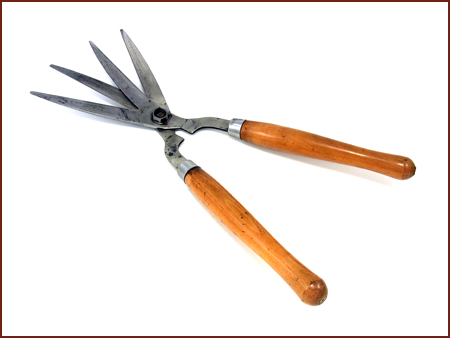
English. Greensleeves double bladed. 21.5 inches (54.5cms).
 Hedging Shears C
English. Mid 20C. ‘W.P. Sheffield’. Ward & Payne. Steel and ash. 21.25 inches (54cms).
 Hedging Shears D
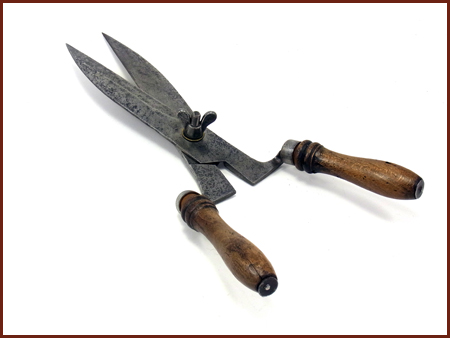
Stamped ‘G’. 17.75 inches (45cms).
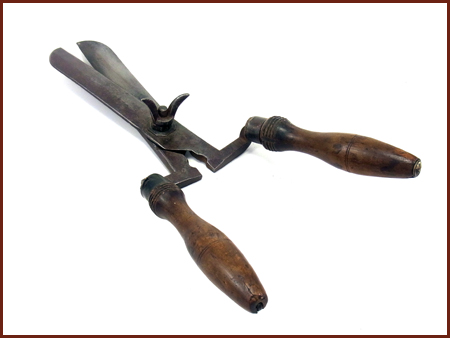 Hedging Shears E
French. ‘Rouiller. P.’ 17.75 inches (45cms).
 Hedging Shears H
French. 19C. Heavy wrought blades.
 Hedging Shears K
21.5 inches (55cms).
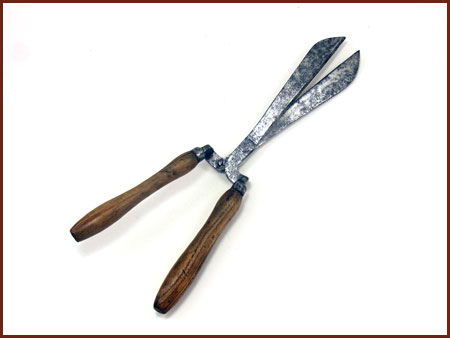 Hedging Shears L
French 19C. Stamped ’15C. Ser***’ 18.25 inches (46.5cms).
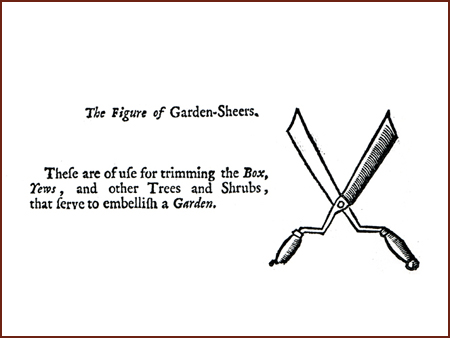
Sub-image from ‘The Compleat Florist’ by Louis Liger DAuxerre 1706 – Sheers.
Please contact us if you require further information.
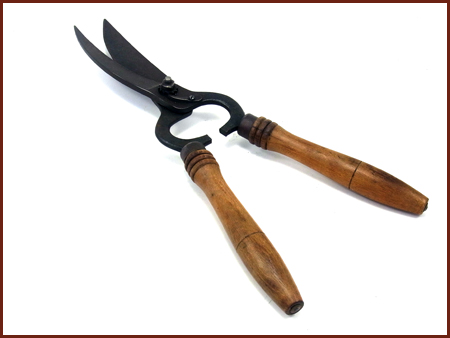 Hedging Shears M
French. 20C. 20 inches (50.3cms).
 Hedging Shears N
English. 19C. From the west country UK. Mid length handles. Wrought iron and ash. 32 inches (81cms).
 Hedging Shears P
English. Ladies or Childs. ‘Signal’. 10 inches (25.2cms).
 Hedging Shears Q
English. Mid 20C. Ladies model. 13 inches (33cms).
 Hedging Shears R
English. Mid 20C. Ladies model. ‘The Valley. Sheffield’. 14.5 inches (36.5cms).
 Hedging Shears S
English. 20C. ‘Signal. Made in England. Gripper Notch Shears’. 18.5 inches (47cms).
 Hedging Shears T
French. C1850. Ladies oak handled and wrought iron blades with tapered outer edges. 15 inches (38cms).
 Hedging Shears U
French. C 1900. Massive smithy made wrought iron with tanged Elm handles and desirable heart shaped stop. 2.6 kgms.
 Hedging Shears V
 Hedging Shears W
 Hedging Shears Y
 Hedging Shears Z
German. 20C. Serrated blade. Traces yellow paint. 21.5 inches (54.5cms).

 Hedging Slasher A
English. Early 20C. Steel blade mounted on ash handle with bolted strap. Blade stamped ‘W Gilpin. Wedges Mills. Warranted’ with familiar cross axes logo. Handle with faded red and yellow label ‘W Gilpin Wedges Mills Cast Steel Warranted’. 37.3 inches (94.7cms).
 Hedging Slasher B
English. C1900. Iron head stamped ‘Elwell. 3747 and 10’. Ash shaft. 39.5 inches (100.5cms).
 Hedging Slasher C
English. C1900. Iron head stamped ‘C T Skelton & Co. Sheffield. Made in England. Ash handle. 46 inches (117cms).
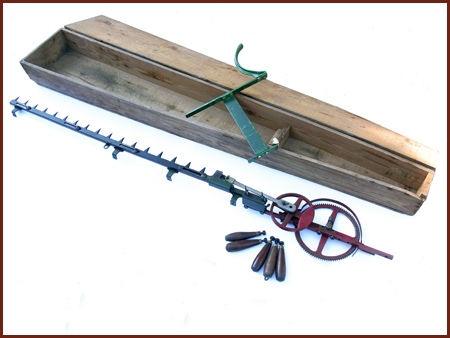 Little Wonder A
British and USA. Little Wonder came in a pine coffin like box with its adjusting tools. It was sold in the 1939 Blue Book at 6 pounds and six shillings and by Marshalls of New York in their 1927 catalogue. It was the most evocative garden tool and also one of the most useless and unreliable. The buyer would have been well to do and certainly have 2 or more gardening staff. Most of these are in good condition and hardly used in most cases for the above reason. USA made by Detco Manufacturing Co. Oaks Montg Penna USA. United States Patent Office patented the system on May 26th 1914.
Using the Dettro “Little Wonder” Hedge Trimmer: This device is useable as either one man or two man operation.
In two-man operation, one cranks and guides an end and the other guides the other end. The following describes use exclusively by one-man.
The trimmer is assembled in two main forms, top cutting where the cutter blade is at 90 degrees rotation from the plane of the crank, and side cutting where the cutter blade is on the same plane as the crank. When the unit is to be assembled as a top cutter, the crank-drive portion, nominally painted red, is directly bolted to the cutter portion, nominally painted green. When the unit is to be assembled as a side cutter, the joining of the cutter part to the crank drive part is accomplished by joining with a metal angle bracket bolted to each portion. In addition, the drive link is remounted between the two parts by mounting the drive rod on the inner hole and attaching the clevis adapter so at rotate the drive thru the 90 degrees.
In the one-man mode, one must use adapter supports to assist as one hand is always used to crank and the other to hold the device. The supports are used in combination with each other as needed.
1. Sling. This is attached at the crank end handle and a point about mid cutter. The sling is adjustable as needed.
2. Chest brace. This is attached at mid joint of the drive to cutter. It is made up of three metal parts, an attachment to the trimmer, a adjustable length brace, a curved chest bracket (adjustable)
3. Thigh brace. This is made up of two parts of the parts used in the chest brace but with a smaller curved bracket for the thigh and is mounted to the cutter bar in one of several drilled positions on the cutter bar.
4. Shoulder brace. This is a curved bracket to another flat bracket, mountable in several positions, with a brace to a point near the crank end.
The sling and chest brace are used when top cutting. The sling length helps get the trimmer to the correct height and the chest bracket holds it away from the body so as to be able to crank. The chest bracket brace is Z shaped so it can be raised or lower depending on how it is mounted.
The shoulder brace and the thigh brace are used when trimming the sides of the hedge. The unit hangs downward, the height is set by how the shoulder bracket is attached to the intermediate part, (there are four possible positions). The thigh brace is assembled to be comfortable as you will use this to push the lower part of the cutter along.
Care and feeding; From time to time, do a twist on the grease caps or add grease. Lightly oil pivot points and blade. Use Paraffin to remove gum from cutters. Tighten bolts.
Sharpening: Normally, this unit is self sharpening as when cutting, the wedge shape of the blade forces the cutters together. If something hard is encountered, causing a burr, you should dress the point with a file. Do not file the teeth where they touch each other.
The blades are adjusted for play by loosening the large lock nut on the back of the cutter and tightening to just touch. Then tighten the lock nut. There are four places this can be done along the blade.
If the gear and pin become loose, DO NOT peen the pin as this might break the cast gear. The pin and the gear are threaded. If that is not enough to get the play out, you might try my solution. I drill and tap the end of the pin and mount it with a screw and washer.
Also British made by John Hansen Astor House Aldwych London WC2 Came with 4 fold instructions for Two man and One man use. Case 63 inches L (159.5cms).
Please contact us if you require further information.


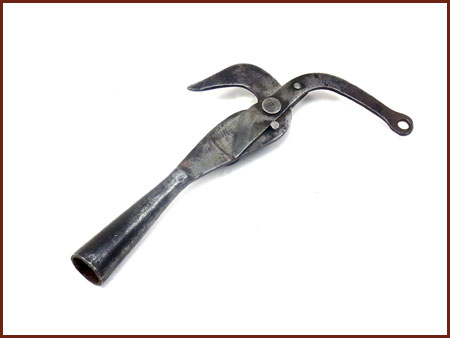 Lopper A
11 inches (28cms).
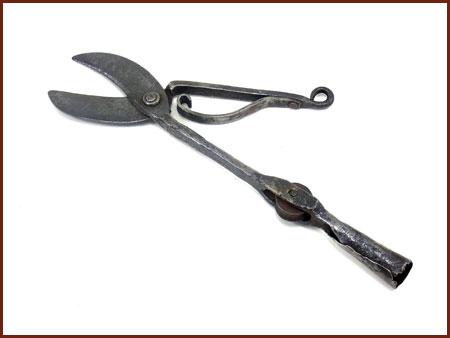 Lopper B
French. C1900. Wrought iron. 14.5 inches (37cms).
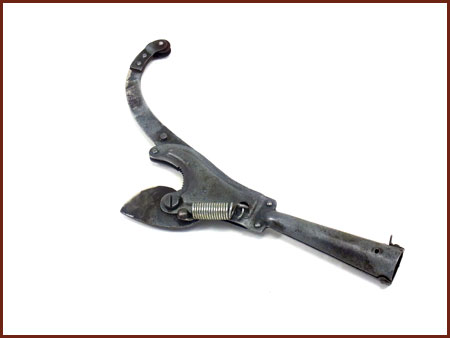 Lopper D
French. Mid 20C. Stamped DRGM. Echenilloir. Ex painted steel with 1 cord pulley and spring. 11.5 inches (29cms).
 Lopper E
French. 20C. Vineyard use. With ivy lever. Steel with riveted beech scales, 3 iron rivets. 17.75 inches (45cms).
 Lopper F
French. 20C. Vineyard use. Steel with single ash handle possibly a replacement and ivy lever. 18.75 inches (47.5cms)
 Lopper H
English 1905. Ref: Follows & Bate Ltd catalogue 1905. Small and large sizes. ‘The Myticuttah’. Also Ref:Wm Wood & Son’s 1909 catalogue and Bentleys 1939 catalogue.
 Lopper I
English 1905. Ref: Follows & Bate Ltd catalogue 1905. Small and large sizes. ‘The Myticuttah’. Cutter 90 degrees. Ref: The Gardeners Chronicle dated Jan 21 1888 states: ‘Manufactured by the Standard Manufacturing Company of Derby UK and based on their ‘Standard Tree Pruner’, The Myticuttah knife is moved by a slide which works up and down the shaft.
 Lopper J
English 1905. Ref: Follows & Bate Ltd catalogue 1905. Small and large sizes. ‘The Myticuttah’. Cutter parallel to handles. Ref: The Gardeners Chronicle dated Jan 21 1888 states: ‘Manufactured by the Standard Manufacturing Company of Derby UK and based on their ‘Standard Tree Pruner’, The Myticuttah knife is moved by a slide which works up and down the shaft.
 Lopper K
USA. 1926. Steel with 3 position sprung ratchet action. 3/4 clad wood handles with twin rivets. Steel imprinted ‘No 2 Forester. Mckenney Type. US Patent 1607470. Made in America. H K Porter Inc. Everett Mass’ and ‘Reg.U.S.HKP. Pat. Office’ plus Logo. 27.25 inches (69cms).
 Lopper L
American. Early 20C. Drop forged alloy steel and beech handles with tangs. Steel remains red paint. Engraved ‘Seymour Smith. Super Cut. Drop Forged Alloy Steel’. 31 inches (78.5cms).
 Lopper O
English. Early 20C. Sheffield made. Ash handles. Collar bolted to plate doubles as stop. ‘Lopping Shears’. Parrot beak. French or Aubert’s pattern. Ref: Holtzapffel catalogue 1925. p9. and Walkers and Holtzapffel Ltd. Baker Street. 1931. p6. Also sold widely by many companies. Ref: Wm Marples & Son ‘Aubert’s Branch Shears’. 31 inches (79cms).
 Lopper R
French. 20C. Steel with screwable tanged beech handles. 17 inches (43cms).
 Lopper S
Lightweight construction steel with beech handles
 Lopper U
English. 20C. Steel stamped ‘Fuluse. Sheffield England’. Tanged beech handles. 16.5 inches (42cms).
 Lopper V
Forged steel. 15.5 inches (39.2cms).
 Lopper W
English. 20C. Steel stamped ‘Cilpin & Whitehouse. Loughborough’. Serrated edge to upper blade. Beech handles. 22 inches (56cms).
 Lopper X
English. 20C. Steel with double branch notch and riveted ferrules. Beech handles. 15.25 inches (39cms).
 Lopper Y
French. Early 20C. Chestnut handles with splits and worm. Fine quality steel head and sprung lock ratchet. 28.5 inches (72.5cms).

 Loppers P
English. 1880’s. Ref: Silber & Flemming 1883. Lopping Shears.
 Loppers Z
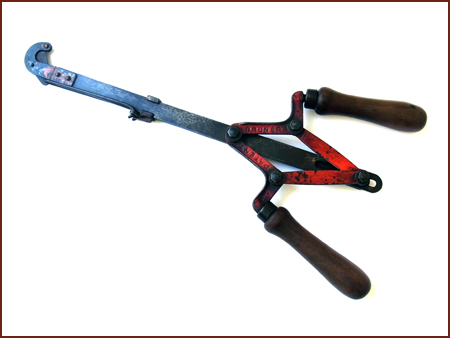
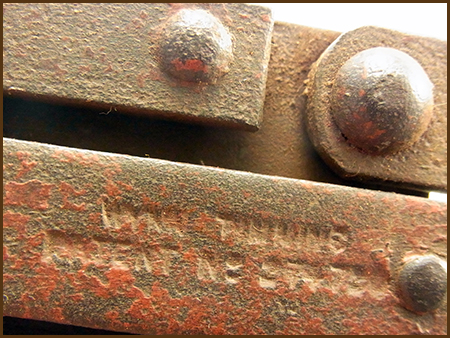
English. C1900. Sliding trapedoidal action with removeable steel sliding blade. Faint traces red paint. Ash handles. Assembly stamped Wynn Timmins. Pat No. 274780. 18.5 inches (47cms).
 Machete A
English. Mid 20C. Machete with high grade steel blade stamped ‘Spear & Jackson’ ‘Made from Sheffield Steel England’ ‘SJ335-18’ and ‘SJ’ logo. Hardwood handle sandwiched to blade with 3 bolts. Tool is unused. 24.3 inches (61.5cms).
 Multicut Shears A
Traces of pale blue paint. 16 inches L (41cms). 12 inches W (30.5cms).
 Multicut Shears B
English. 1930’s. ‘Spongs garden hedge trimmer’. 9 double bladed steel constuction with beech handles. Stamped and labeled ‘Spongs’ and Reg No. 721910. Ref: George Harding. 1935. Ref: Holtzapffel catalogue 1931. p23. 15 inches L. (37.5cms). 8 inches Dia blades (21cms).
 Multicut Shears C
Danish. C1930. ‘The Crab’. Pat 298043. Sold by Jon Hansen. Astor House. Aldwych. London WC2. Also sold by Holtzapffel catalogue 1931. p19. 16.5 inches L (42cms). 12 inches W blades (30.2cms).


 Multicut Shears D
English. C1935. ‘The Astor’ by The Rexa Lawnmowing Company. Woking. UK. Main components are stamped and pressed from steel plate. The cutter bar and knives are hardened and ground. Handles turned from beech. A brass plate on one handle bore name and address of Rexa. It made four cuts on opening and another four on closing or eight in a cycle First patented in 1929. The cost in 1935 was twelve shillings and sixpence. (67.5 pence). Ref. Historic Garden Tools p26. Ref: Carters Blue Book 1939 ‘The Astor Shears’ – ‘four pairs of shears in one’ 12/6d. Ref: Wm Wood catalogue 1958 ‘The Asto’ (sic) 13/9 each. 16 inches L (41cms). 9 inches W (22.2cms).

 Multicut Shears E
British. ‘The Remex 33’ Hedge Trimmer. Pat 708485. Spring operated. 16.5 inches L (42cms). 12 inches W (30cms).
Please contact us if you require further information.

 Multicut Shears F
English. 1950. Code ‘Halftime’ slide action clipper. Push pull ball grip. Patent dated 31 Aug 1950. 21 inches L (53cms). 8.5 inches W (21.50cms).

 Multicut Shears G
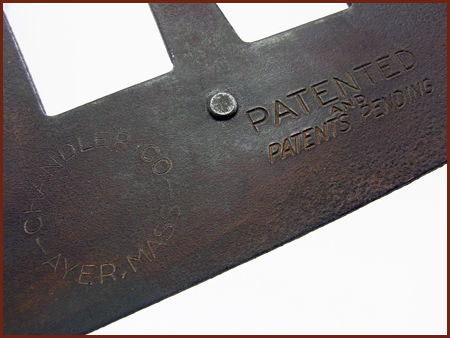
American. Mid 20C. ‘Chandler Co. Ayer Mass. See English model ‘Code Half Time patented in 1950. 26 inches L (65.5cms). 9 inches W (22cms).
Please contact us if you require further information.
 Multicut Shears H
English. Early 20C. ‘Ridgeways’ patent Hedge Clipper. Fine serration to blade edges. 7 Blade model. Ref: The Gardeners Chronicle 21 July 1883 illustrated a 12 blade, 12 and 18 inch model. These were made in 1900’s by C T Skelton. Sheffield. Ref: Holtzapffel catalogue 1931. p18. Earlier design with 12 blades sold by Follows & Bate in 2 sizes in 1905. Ref: Wm Wood & Sons catalogue 1909 showing 9 blade model. 12 and 18 inch blades offered. 21 inches L (53.5cms). 14 inches W (35cms).
 Multicut Shears J
English. 1878. Steel sliding reciprocating blades and chestnut handles. Stamped on blade ‘E P Shaw. Pat D. Feb 16 1878’. W 18.4inches (66.7cms) x L 14.8 inches (37.7cms).
 Multicut Shears K
English. Early 20C. Steel 4 blade cutter stamped ‘Prov Pat No.31953/38’. Beech handles. 17.2 inches (43.5cms).
 Pruner A
English Mid 20C. Tree Pruner or short reach Pruner. Ref CGA catalogue 1953. 47.5 inches (121cms).
 Pruner D
English. Mid 20C. ‘Kenet Trade Mark. Made in England’ Black rubber hand grip. 17.5 inches (44.5cms).
 Pruner E
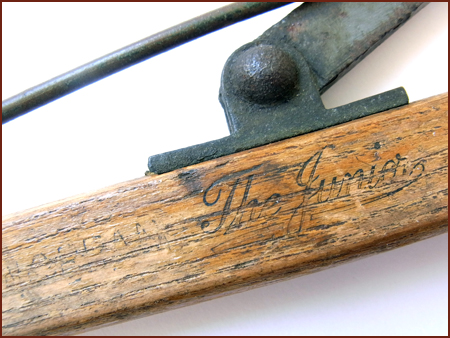
Child’s model. ‘The Junior’. 30 inches (76cms).
Please contact us if you require further information.
 Pruning Hook A
French. 20C. ‘Gouvy@. Croissant or C shaped blade. Head only. Would have had long handle for reaching high branches.
 Pruning Hook B
French. Early 20C. Ecimeur for summer vine pruning. Bordeaux region. Steel blade inserted into slot in handle and fixed with rivets and ferrule. Pine handle. 20 inches (51cms).
 Pruning Hook C
French. 19C. Wrought iron. ‘Serpe a douille’. Ref Daniel Boucard. Les outils taillants. Fig 180.
 Pruning Hook D
English. 20C. Steel. ‘Made in England’. Identical to ‘Emondoir. Coup-Gui. (Mistletoe cutter lit.). Ref. Daniel Boucard. Les outils taillants. Fig 331.
 Pruning Hook F
French. 19C. Wrought iron. ‘Serpe a douille’. Ref Daniel Boucard. Les outils taillants. fig 179.
 Pruning Hook G
C1900. Raspberry or Gooseberry Cane Cutter. Steel with ash handle. 13.75 inches (37cms).
 Pruning Hook H
English Early 20C. Steel with beech handle. ‘Especially useful for Gooseberry and other fruit bushes which have thorns’.Ref: Holtzapffel catalogue 1931. p21. 13.75 inches (34.7cms).
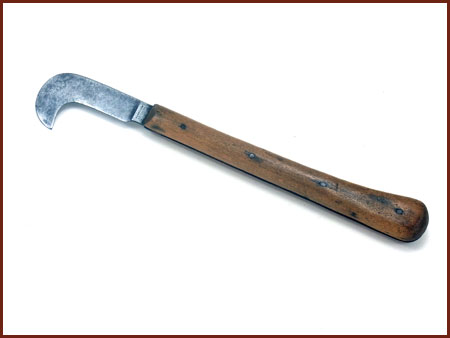 Pruning Hook I
English. C 1900. Stamped ‘Harrison Brothers & Howson. Raspberry Pringng Hook or Gooseberry Pruning Hook. Steel and beech. 12.5 inches (32cms).
 Pruning Hook J
English. C1900. Raspberry Cane Cutter. Steel and Stag horn. Stamped ‘Saynor. Cooke. & Ridal’ and ‘Obtain’. 13 inches (33cms).
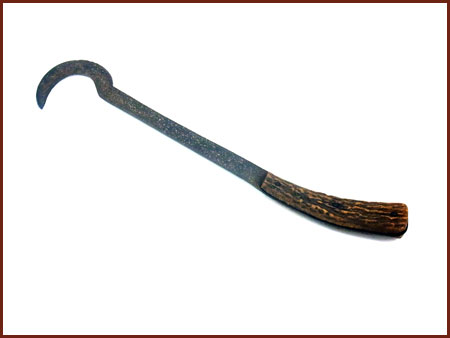 Pruning Hook K
Raspberry Cane Cutter. Steel and Stag Horn. 11.5 inches (32cms).
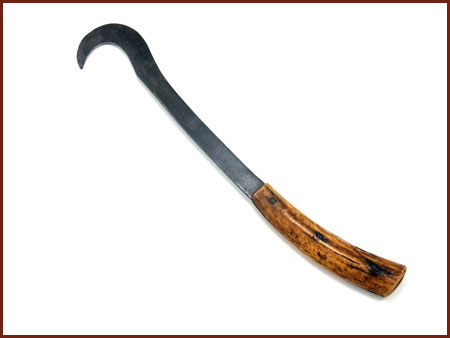 Pruning Hook L
English. C1900. Raspberry Cane Cutter. Steel and Stag horn. Stamped ‘Saynor. Cooke. & Ridal’ and ‘Obtain. Warranted’. 13.25 inches (32.5cms).
Please contact us if you require further information.
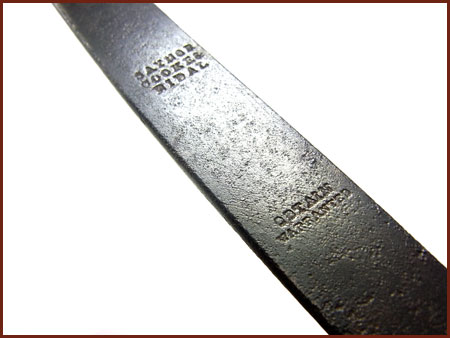
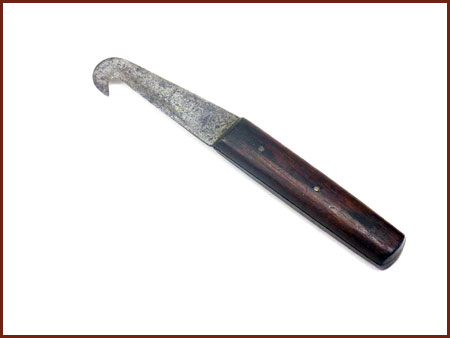 Pruning Hook M
Hooked steel blade with riveted hardwood handle. 7.25 inches (18.3cms).
 Pruning Hook N
French. 19C. Ornate hook on steel blade for pulling in plant before cutting. Distressed hardwood handle with hanging hole. Steel ferrule. 13 inches (33cms).
 Pruning Hook O
Steel hook wrought from rod. Angled ash handle with 2 copper rivets. 24.9 inches (60.3cms).
 Pruning Knife C
English. C1900. Small Billhook. Steel blade stamped ‘Brodie. Hornsey Rd’. Fine beech handle. 9.5 inches (24cms).
 Pruning Knife I
 Pruning Knife K
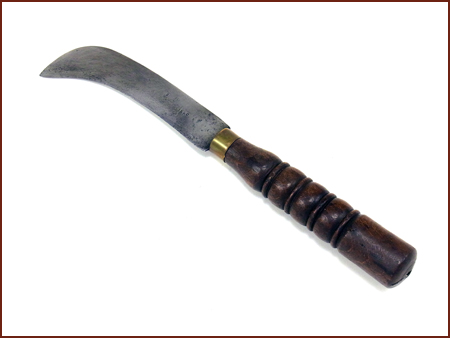 Pruning Knife Q
English. 20C. Kent hop knife made in Sheffield. Steel with turned beech handle and brass ferrule. 10 inches (25.5cms) x 1.75 inches (4.5cms).
 Pruning Knife R
English C1900. Stamped on beaked steel blade ‘J W Stutter. Manufacturer. 184 Shoreditch’. and ‘London’ and ‘4’. Brass ferrule and turned ash handle. 9.25 inches (23.5cms).
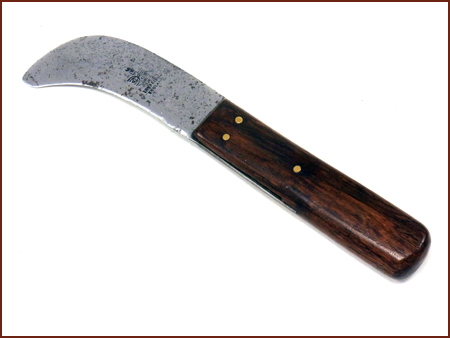 Pruning Knife S
English. 20C. Steel hooked blade and rosewood handle with 3 brass rivets. Stamped ‘Spider’ with spider logo and ‘Sheffield. England’. 7.5 inches (18.5cms).
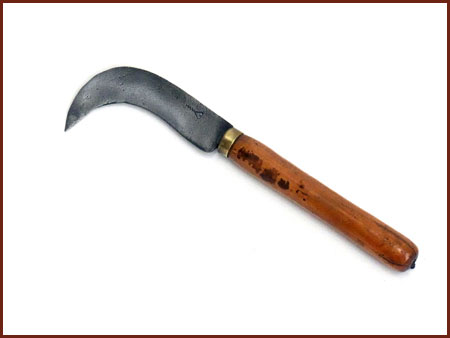 Pruning Knife T
French. Small tanged steel blade stamped heart shaped logo. Brass ferrule and boxwood handle. 7.5 inches (18.5cms) x 1.75 inches (4.5cms).
 Pruning Knife U
English. 19C. Steel Bill Hook with worn wood handle. Stamped ‘No 7. George ***’. 12.25 inches (31cms).
 Pruning Knife V
C 1900. Pruning Knife with thick steel blade heavily chamfered at tip and cutting edge. Mahogany scales with 3 steel rivets. 9.8 inches (25cms).
 Pruning Knife W
French. c1900. Vine pruning. Subimage shows logo and initials.
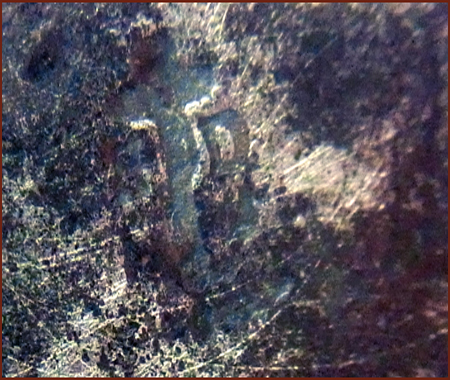
 Pruning Knife X
English. Early 20C. Curved steel tanged blade stamped ‘Hutton & Co. Made in England’. Ash handle with circumferential detailing. 11 inches (28cms).
 Pruning Saw AA
French. Beech pistol grip riveted to serrated push/pull steel blade with hook by 2 copper rivets. 14 inches (35.5cms).
 Pruning Saw AB
French. Early 20C. Toothed tanged steel blade stamped ‘****’. Wood handle. 12.6 inches (32cms).
 Pruning Saw AC
French. C1900. Steel toothed blade stamped ‘Goldenberg’. Pale wood handle. 2 steel rivets. 12.2 inches (31cms).
 Pruning Saw AD
French. C1900. Toothed steel blade with branch hook stamped ‘Aubin Fils. *ou Commerce 57. Nevers’. Boxwood handle. 2 steel rivets. 14.2 inches (36.4cms).
 Pruning Saw AE
French. C1900. Tapered steel tanged blade with hook and bentwood yew handle. 15.25 inches (38.7cms).
 Pruning Saw AF
French. C1900. Tapered steel tanged blade with ash handle. 16 inches (40.5cms).
 Pruning Saw B
English. 20C. 19.75 inches (50.2cms).
 Pruning Saw C
Deer antler and steel toothed and hooked blade. 2 rivets. 16.25 inches (41cms).
 Pruning Saw D
French. C1900. Stamped ‘Plattner a Chambery’. M Plattner was a cutler and in an article in Courrier des Alpes in June 1863 there is description of a presentation of his garden tools at a local garden competition in Chambery Savoie. Steel double toothed blade with branch hook. Stag antler handle. 2 rivets. 16.5 inches (42cms).
 Pruning Saw E
English. 20C. Elwell 18 inches (46cms).
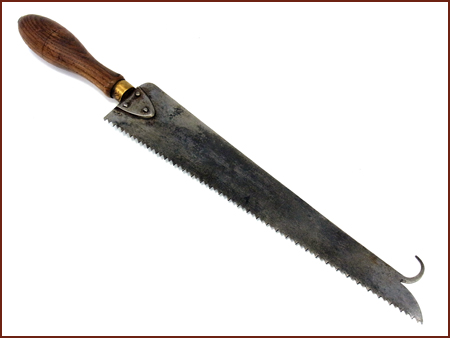 Pruning Saw F
French. C1900. With branch hook. (Bill) 19 inches (48.7cms).
Reminiscent of an early design featured in ‘Gardening Complete Guide’ from Ward Locke c1890. Tools See sub-image below.

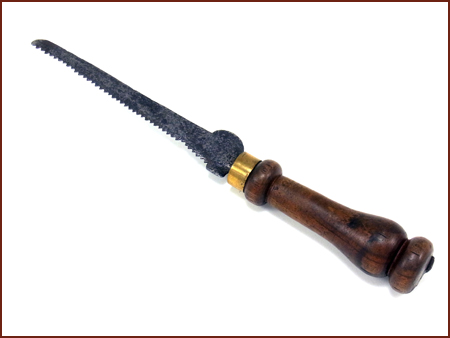 Pruning Saw G
French. C1900. Pruning Saw. Steel with turned beech handle and brass ferrule. 11.75 inches (28.6cms).
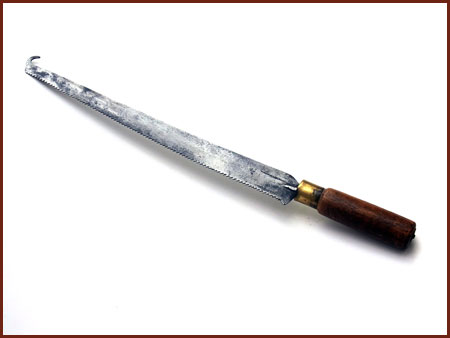 Pruning Saw H
French. 20C. ‘A Versailles’. 18 inches (45.5cms).
 Pruning Saw I
Double toothed hooked steel blade and mahogany handle with 3 brass and steel rivets. 15.8 inches (40cms).
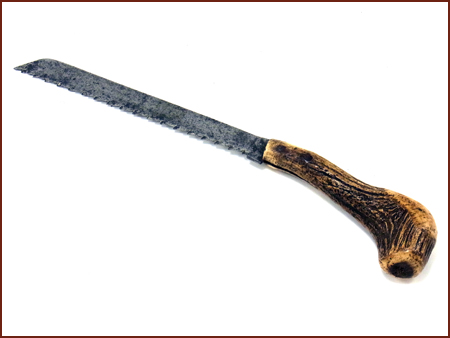 Pruning Saw J
Steel and stag antler. 10.5 inches (27cms).
 Pruning Saw K
French. 20C. Steel pulling toothed blade stamped ‘790’. Curved wood handle and 2 brass bolts. Wood scabbard with 2 steel riveted bands. Sheathed 22.3 inches (56.8cms).
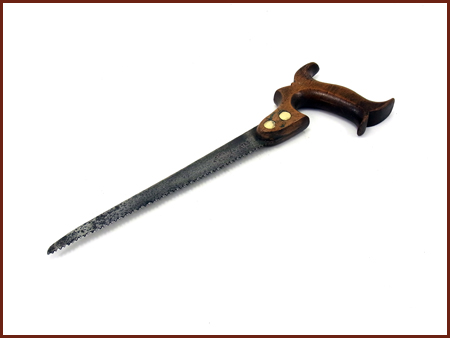 Pruning Saw N
English. 1920’s. Ref William Marples & Sons catalogue 1926. Lightning Compass model Pruning Saw. 15.5 inches (39cms).
Please contact us if you require further information.
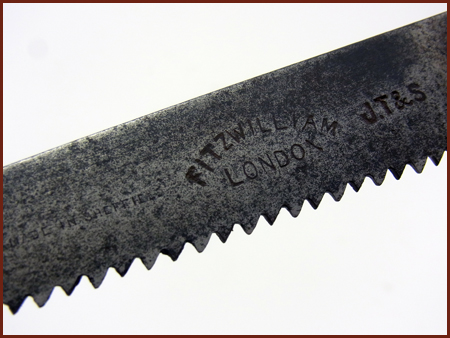
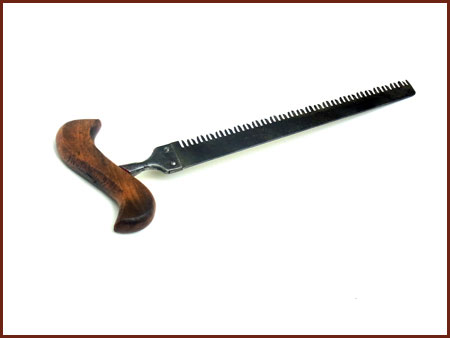 Pruning Saw O
British. Mid 20C. ‘Rolcut No12. Retail cost was 5 shillings. Ref: Calvert 1963. p30. 14.5 inches (37cms).
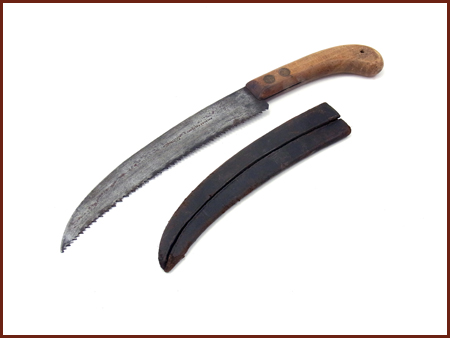 Pruning Saw P
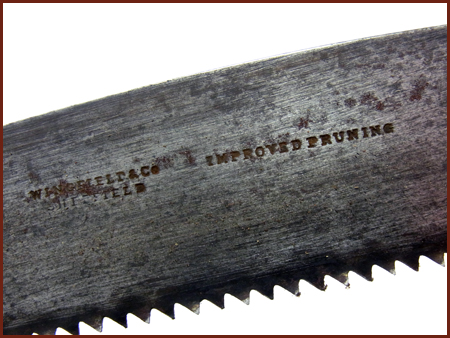
English. Early 20C. Wingfield & Co Sheffield. ‘Improved Pruning’. With leather sheath. 16 inches (40.3cms).
Please contact us if you require further information.
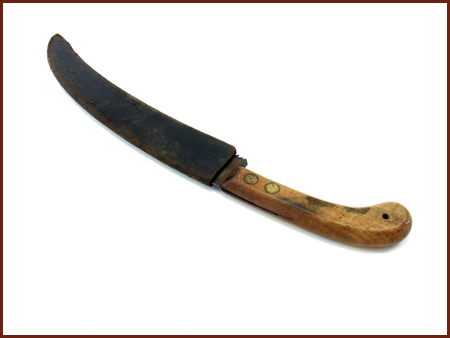
 Pruning Saw Q
French Early 1900’s with fruitwood handle. L 21 inches (53cms) x W 5.5 inches (13.7cms).
 Pruning Saw R
English. 20C. 22 inches (56.5cms).
 Pruning Saw S
French. 20C. Stamped ‘Majo’ L 16.25 inches (41.3cms) x W 4.5 inches (11.2cms).
 Pruning Saw T
Steel serrated hooked blade. Beech handle. Traces red paint on socket. 72 inches (180cms).

 Pruning Saw U
British foreign made 3 bladed Saw. Copy of Saw Ref: Baxendale & Co Manchester 1910. p70. 20 inches (51cms).
 Pruning Saw V
French. C1900. Curved double edged serrated knife. Beech handle. 9.25 inches (23.5cms).
 Pruning Saw W
Steel curved blade. Ash handle. 3 brass fixings. 44 inches (111.7cms) x 2.25 inches (6cms).
 Pruning Saw X
Removeable Steel blade and beech handle. 62 inches (157.3cms) x 2.25 inches (6cms).
 Pruning Saw Y
American. 20C. Curved Pruning Saw with leather sheath. Sheath stamped ‘***LETT Mfg Co Detroit Mich’. Metal hanging clip on handle. Sheathed 30.5 inches (78.5cms) x 6 inches (15.5cms).
 Pruning Saw Z
Deer antler and steel toothed and hooked blade. 14.5 inches (36.8cms).
 Pruning Shears A
English. 19C. Fine quality instrument with steel sliding cutting blade. Bone inserts riveted on handles. Missing Spring leaf and locking catch. Stamped ‘Holtzappfel’. 8.5 inches (21.6cms).
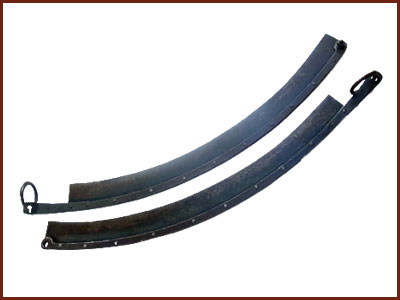 Reed Cutter
Brades. England. The linked blades were dragged along the river bed with chains by two men. L each 41 inches (104cms).
 Saw B
Saw B
English. Early 20C. Tree branch Saw. Ref. Wm Wood 1938 catalogue. 45 inches (114cms). Was sold in leather case as Government surplus new item. Ref: Holtzapffel catalogue 1931. p18.
 Scythe B
Pea Scythe. English early 20C.
 Scythe C
 Scythe D
 Scythe E
 Scythe F
 Scythe G
 Secateurs A
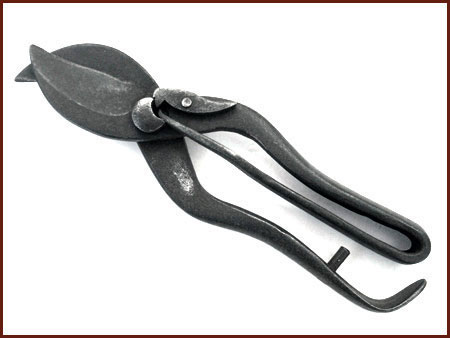
French made ‘Auberts improved double cutting’. Hand forged. Offered by Holtzapffel in 1925 and Carters in 1931. These were later made in Sheffield in 1883. Ref Brown & Sons 1934 catalogue as ‘The genuine Aubert’s double cut’. Browns offered 2 makes; ‘The best French make’ and English make’ Sheffield Steel. 8 inches (20.3cms).
 Secateurs AAA
English. 20C. Stamped logo with ‘England’ in centre. Compression spring. Locking swivel below spring. 8.8 inches (22.3cms).
 Secateurs AAB
 Secateurs AAC
French. 20C. Grape thinning Secateurs. Stamped ‘Depose’. Later replacement leather securing clip. 8.3 inches (21.3cms).
 Secateurs AAD
French. 20C. Grape thinning Secateurs. Pressed steel handles and wire locking clip. 7.5 inches (19cms).
 Secateurs AAE
C1900. Steel with longitudinal sliding guillotine blade. Locking catch. Very pitted condition. 9.25 inches (23.5cms).
 Secateurs AAF
American. late 1800’s. Steel and brass with paired brass springs and locking clip. Stamped ‘Seymour Smith & Son’. Made in Oakville Connecticut USA. 9 inches (23cms).
 Secateurs AAG
Late 20C. Multitool with stainless secateurs and many others in green canvas bag. Black bakelite scales. 7.8 inches (20cms).
 Secateurs AAH
English. C 1900. Bone handled scales and locking clip. Stamped with geometric logo. 8.5 inches 21.5cms.
 Secateurs AC
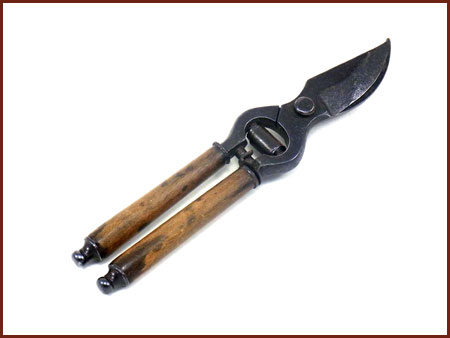
Steel with turned beech handles and metal finials. Coil spring with locking swivel below. 9.3 inches (23.2cms).
 Secateurs AD
English. 1925. ‘The ‘Plucca’ Pruner’. These used a novel cam for holding the cut piece. This was one of the first holding devices. Secateurs were invented in 1815 by Bertrand de Moleville in France. Ref Holtzapffel & Co Ltd. Haymarket. Garden Tools and Sundries 1925. p7. 8.25 inches (21cms).
Please contact us if you require further information.
 Secateurs AF
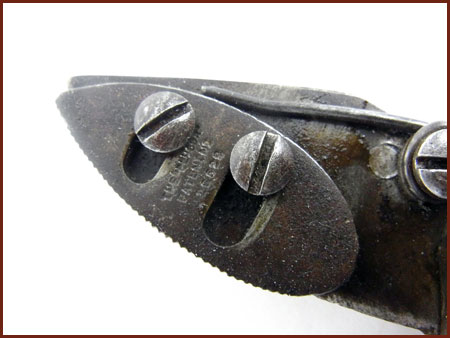
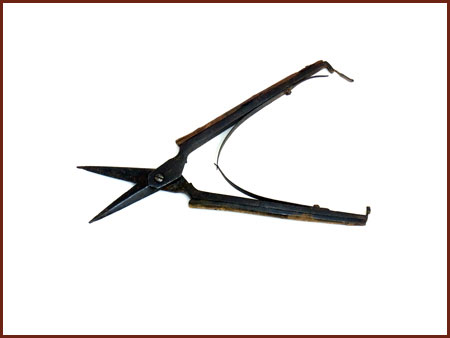
French. Late 19C. Grape pruning secateurs with wooden scales. Paired leaf spring. Locking latch. 10 inches (25.4cms).
Please contact us if you require further information.
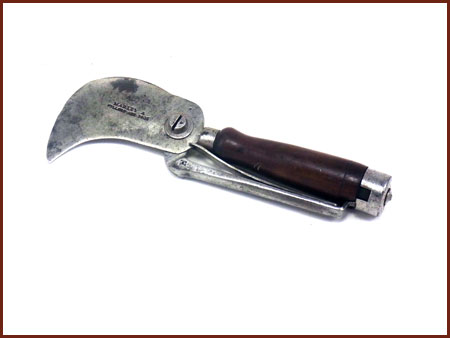 Secateurs AG
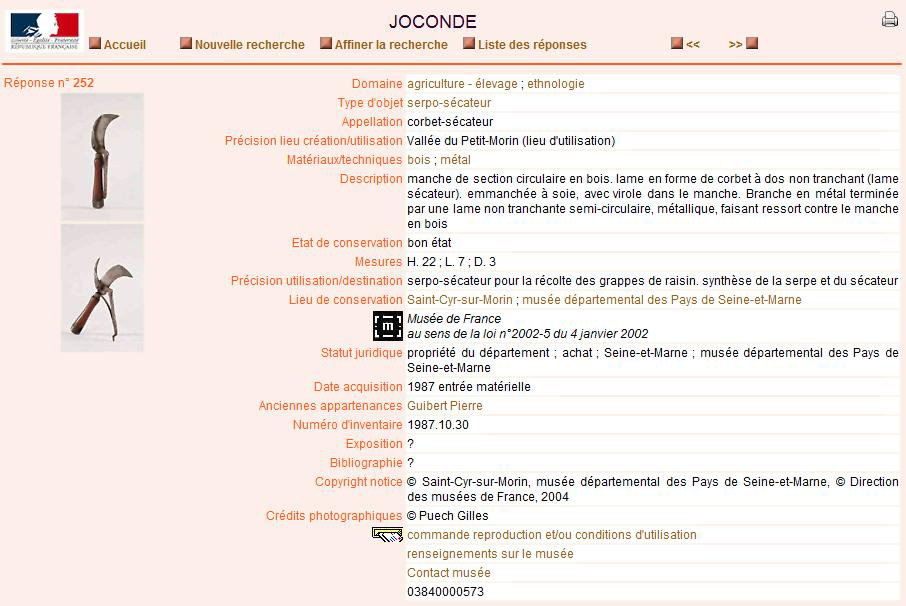
French. 1850. Opposite hand to Secateurs L. Serpo-Secateurs. Ref: Daniel Boucart illus. Stamped ‘J’ ‘Marizy a Villiers-au-bois’. C1850. Serpo-sécateur : Cet outil est aussi appelé « corbet-sécateur », ou encore « sécateur Champenois ». Il a peut-être inventé au 19° siècle par M. MARMUSE, coutelier à Paris (voir les photos jointes), puis fabriqué par d’autres couteliers, notamment en Champagne. Son design le distingue vraiment des autres sécateurs. Secateurs invented in 1815 by Bertrand de Moleville in France
Please contact us if you require further information.

“

“
 Secateurs AH
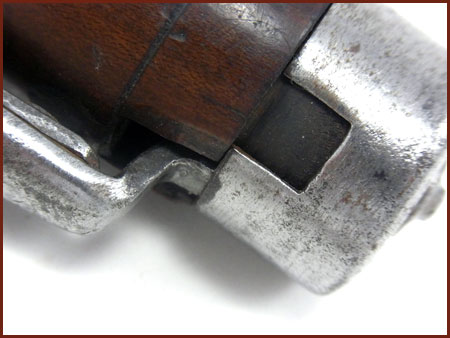
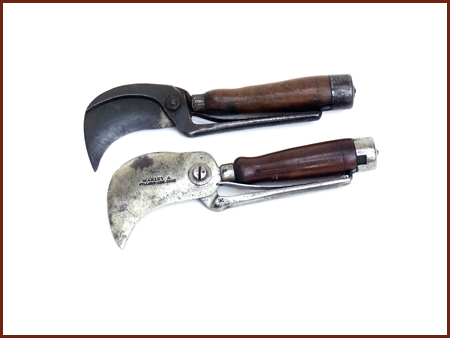
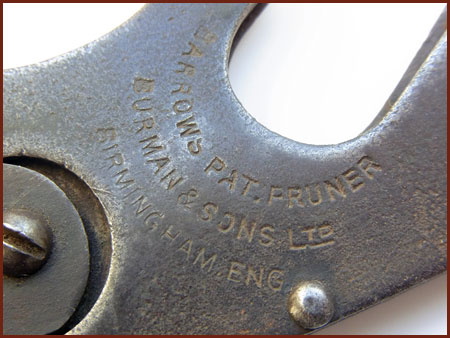
‘Barrows Patent Pruner’ was made in early 1900’s by Burman & Sons Ltd in Birmingham. There were 2 models.The sliding cut was effective but an example of over engineering possibly. Ref: Holtzapffel& co Ltd Haymarket. Garden Tools and Sundries 1925. p6. 9.5 inches (24cms) x 2.75 inches (7.1cms).
 Secateurs AI
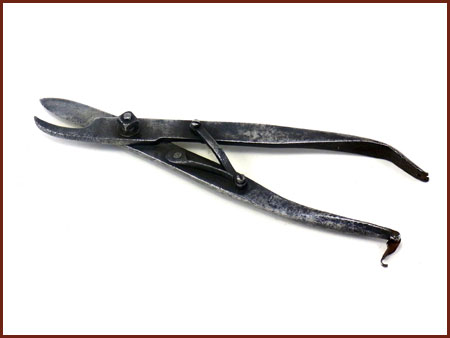
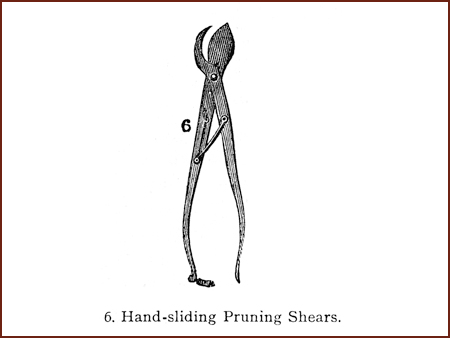
English C1830. Stamped ‘W Crown R’. Stamped also ‘?Brookes’. Intact locking clip. Double nut. William IV 1830-1837. Ref J & G McHattie 1872 p115 McHattie has sliding Saynor Secateurs and Saynor cutting edge tools. Subimage shows ‘Sliding shears – Gardening Complete Guide from Ward Locke c1890’ 9.3 inches (23.5cms).
Please contact us if you require further information.
 Secateurs AJ
English. C1910. Wynn Timmins. Stamped ‘Wynn Timmins. Heart shaped logo’. Patent 274730. Barrows type captive sliding blade. 9 inches (23cms).
 Secateurs AK
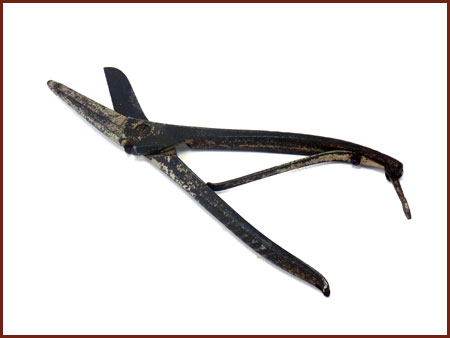
Early 20C. All steel with traces chromium plating. One blade snub nosed with wire cutting notch, leaf spring, serrations on grips and locking pad. 8.25 inches (21cms).
 Secateurs AL
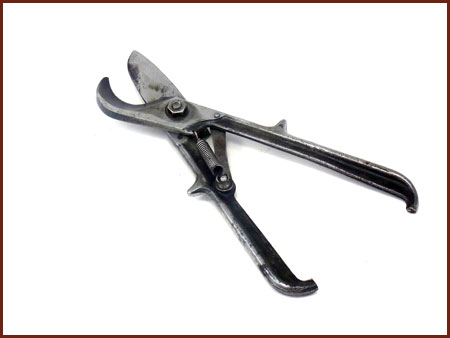
English. C1930’s. Ref: Bentleys catalogue 1939. Stamped ‘B’ and ‘Wilkinson Knife Cut’. 9 inches (23cms).
 Secateurs AM
Bone handle covers. Colied wire spring. Wire locking hoop. 6.75 inches (17cms).
Please contact us if you require further information.
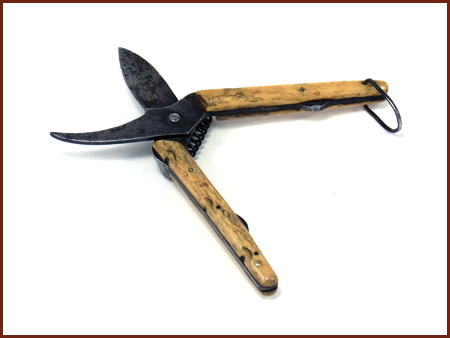
 Secateurs AN
French. Early 20C. Serpo-Secateur. Serpe attached to blade. Paired leaf springs. Detachable locking band. Brazed brass insert. 8.75 inches (22cms).
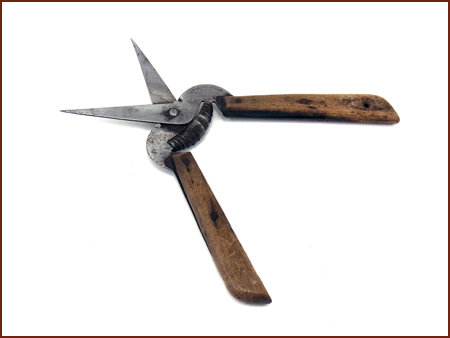 Secateurs AO
French. Grape thinning secateurs. ‘Le Vendangeur’. Beech handles. Missing wire clip. Also sold in UK by Monro of Covent Garden in their 1951 Handbook and Catalogue. 7.75 inches (19.5cms).
 Secateurs AQ
Scalloped blades for sizing stem. Compressible spring. Linking clip. 8.3 inches (21cms).
 Secateurs AR
English. 20C. Tiny Ladies model. Coil spring. Stamped circular motifs. Chrome plated steel with locking clip. 5.5 inches (14cms).
 Secateurs AS
British. C1950’s. ‘The Pocket Pruner’. Steel with serrated non slip handles and locking catch. 6 inches (16cms). Ref: Skeet & Jeffes Woking. Garden & Estate Guide 1954. p6. 6.3 inches (16cms).
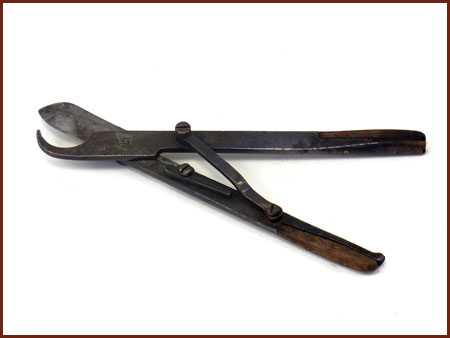 Secateurs AU
English. 19C. Mahogany handled steel Secateurs with sliding action. Stamped ‘W Marple & Son’. Broken catch. 8 inches (20.3cms).
Please contact us if you require further information.

 Secateurs AV
English or French. French design. Made in Sheffield England since 1883. Auberts pattern. 7 inches (18cms).
 Secateurs AW
English. 20C. Steel with green painted handles. Compression spring. Stamped ‘J Marples & Son Sheffield England’. 6.4 inches (16.4cms).
 Secateurs AX
English. 1980. Yellow rubberised handle covers. Coil spring and locking catch. ‘Betacut’ brand. 6.6 inches 16.2cms).
 Secateurs AY
Steel with compressed coil spring, locking link and demountable blade. 8.2 inches (21cms).
 Secateurs AZ
French. 20C. Vine pruning with ivy hatchet leaf springs and leather strap. Partial stamp ‘*ERRAN’. 10.9 inches (27.7cms).
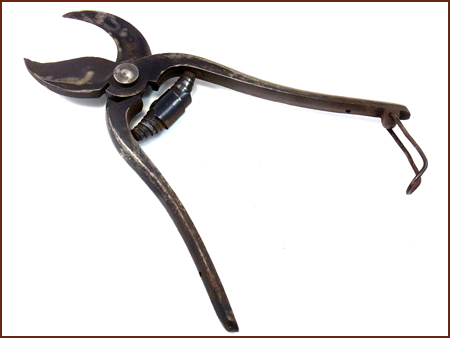 Secateurs B
 Secateurs C
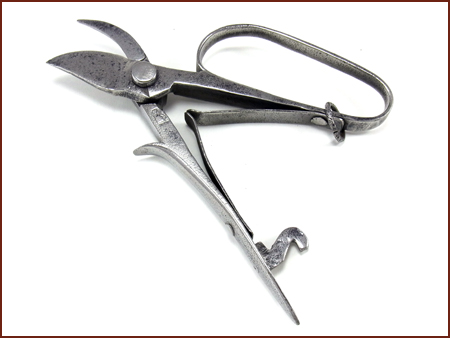
Polished steel. Paired leaf spring. Locking catch and ring. Stamped ‘Logo’ on handle. 8 inches (20.3cms) x 3.25 inches (8.2cms).
 Secateurs D
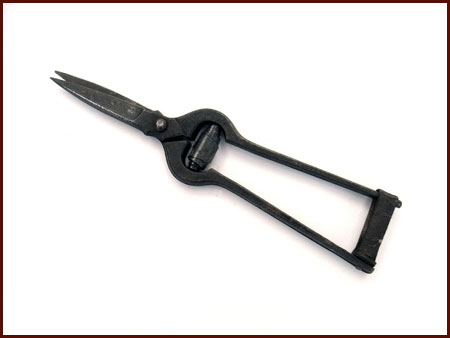
French 20C. Grape thinning secateurs. Steel with leather closing strap. 8 inches (20cms).
 Secateurs F
Blades bolted on. Sprung coil. Locking clip. 7.75 inches (18.5cms).
 Secateurs G
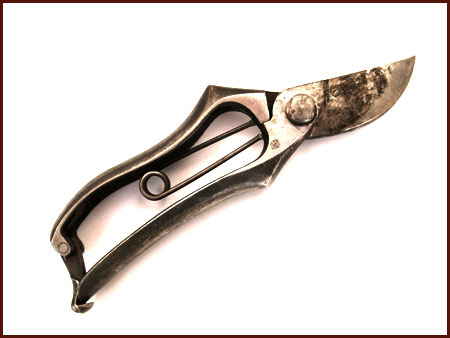
Japanese. Late 20C. Nippon Kakoh Seishi K K. Original box with monochromatic japanese characters. Stamped made in Japan. 7.7 inches (20cms).
 Secateurs H
English. Stamped ‘Erco. Reading. 1614’. Hollow moulded handles. Offset blades. Wire spring and locking loop. 7 inches (18cms).
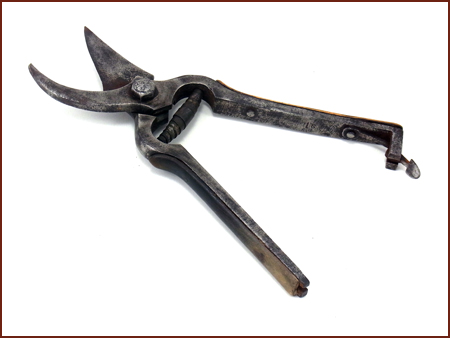 Secateurs I
French. Late 19C. Stamped ‘1. 6. detaille. *AK’. Horn scales. Locking clip. 8.5 inches (21.6cms).
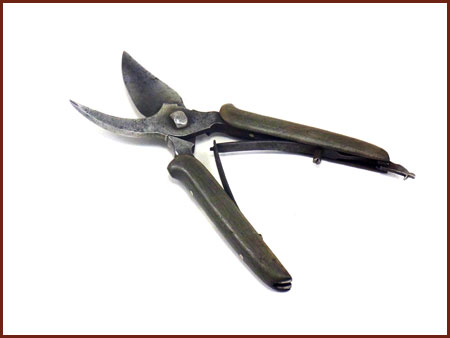 Secateurs J
French. C1850. Twin leaf springs. Horn scales. Sprung locking clip. Round dome headed bolt and square nut fix blades. Stamped ‘Nogent’. Nogent is in Haute-Marne and is the home of Nogent cutlery which has existed from the 17thcentury to today. The screw fixing the blades dates this to prior to 1855. 5.5 inches (13.8cms).
 Secateurs L
French. C1850. Opposite hand to AG. Secateurs were invented 1815 by Bertrand de Moleville in France. Serpo-Secateurs. Ref: Daniel Boucart illus. Stamped ‘J’ ‘Marizy a Villiers-au-bois’. C1850. Serpo-sécateur : Cet outil est aussi appelé « corbet-sécateur », ou encore « sécateur Champenois ». Il a peut-être inventé au 19° siècle par M. MARMUSE, coutelier à Paris (voir les photos jointes), puis fabriqué par d’autres couteliers, notamment en Champagne. Son design le distingue vraiment des autres sécateurs. 8.3 inches (21.3cms).
Please contact us if you require further information.

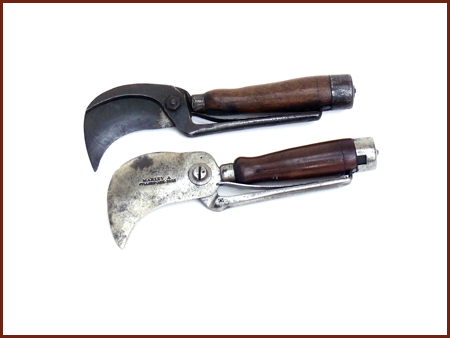
 Secateurs M
French. 19C. Bone scales. Paired leaf springs. Locking clip. 8.25 inches (21cms).
 Secateurs P
French. Vine pruning Secateurs. Hatchet attachment to blade. Sprung coil. Sprung locking clip. Stamped ‘Maurier’. 11.5 inches (29cms).
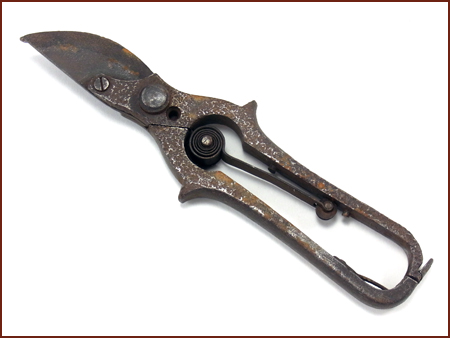 Secateurs Q
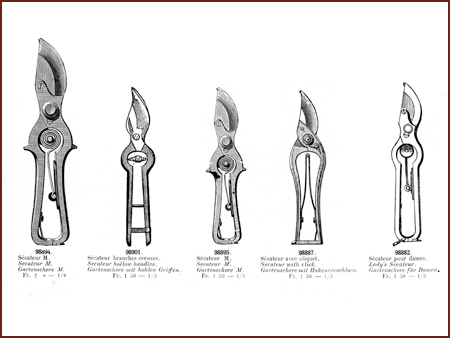
French. C 1900. Coil spring. 7.9 inches (20cms). Ref Holtzapffel & Co Haymarket. Garden Tools & Sundries 1925. p6.
Sub-image shows illustration from Vilmorin catalogue of 1910.
Please contact us if you require further information.
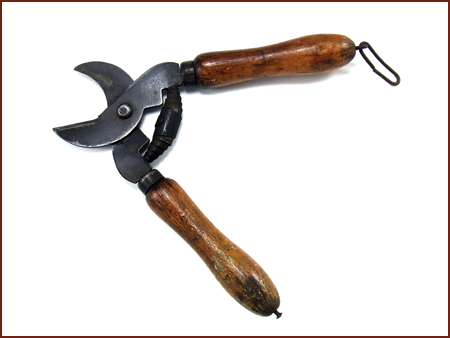 Secateurs U
English. Mid 20C. Beech wood handles and simple wire closing clip. 7 inches (18cms).
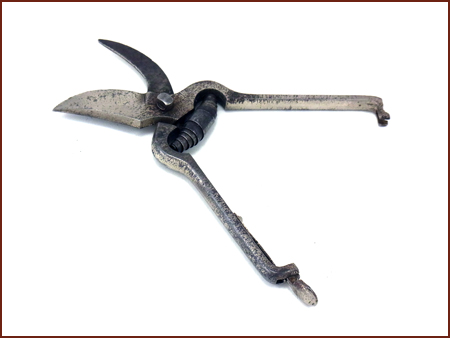 Secateurs X
English/German. Tiny ladies model. Stamped ‘Crest. Germany’ + circular motifs. Coil spring. Flat locking clip. 5.75 inches (14.5cms).
 Secateurs Z
Moulded steel. Paired brass leaf springs. Brass locking loop. 8.75 inches (22.5cms).
 Sickle A
French. Fruitwood handle Slender steel tanged blade. Blade stamped ‘SW.FT&*’ and ‘2’. 20.5 inches (52.3cms).
 Sickle AA
French. C1900. with belt hook. Fruitwood handle. 23.3 inches (59.2cms}.
 Sickle AB
Asian. Rice Sickle with fine serrations to blade and decorative hardwood handle. 16.3 inches (41.7cms).
 Sickle AC
French. 20C. Vine pruning. Hangs on finger and useful for tying and cutting string. 5 inches (12.8cms).
 Sickle AD
Stamped ‘PRF’ with ash handle.
 Sickle B
English. Early 1900. Stamped ‘Brades No.2 106 on steel blade. Pale wood ‘cotton reel’ handle with tang. 21 inches (53.5cms).
 Sickle E
19C. Wide dished steel blade and ash handle with hanging staple. 19 inches (48.4cms).
 Sickle G
Asian. Rice harvesting. Placed here in ‘weeding’ for grouping. Decorated hardwood handle with brass inlays. Brass laminate laid to base of finely serrated blade. Brass ferrule. 16.4 inches (41.6cms).
 Sickle H
Serrated blade. Steel ferrule double riveted to tapered wood handle. 13.8 inches (35.2cms).
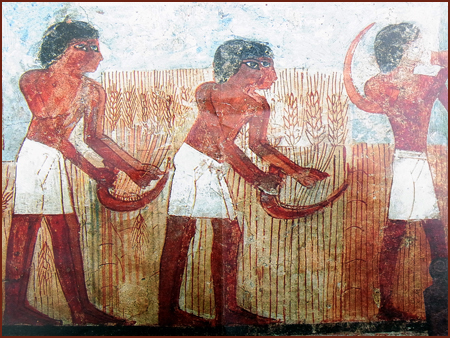 Sickle History A
Egyptians 1450 BC.
 Sickle K
French. C1900. Re-usage de faux example. Twin bolts attach blade. Art populaire. Epoignee de type egoine. Bordeaux region. Ref. Daniel Boucard. Les outils taillants. Fig 83. 22.25 inches (56.5cms).
 Sickle L
Parallel pitted steel blade stamped with logo and illegible lettering. Steel ferrule. Wooden handle. 21.3 inches (54.5cms).
 Sickle M
Asian. Rice harvesting. Placed here in ‘weeding’ for grouping. Fine steel blade on cantilevered rod arm. Decorative serrations on blade.handle with fine turned finial. 16.2 inches (41.3cms).
 Sickle N
English. Mid 20C A Reap Hook by Thomas Booth Co. Bellbroughton. Fine steel tanged blade and ash handle. Blade stamped ‘TBC. 3. No.60’. 17.2 inches (43.5cms).
 Sickle O
Steel blade stamped with ‘M’ logo and ‘00000’ ‘**ENN*’. Fruitwood handle with tang. 12.5 inches (32cms).
 Sickle P
Curved steel blade riveted to cantilevered arm with tang and washer. Ash handle. Stamped ‘I.H’ 19.6 inches (50.5cms).
 Sickle Q
French. 1864 to 1867. Stamped ’90’ Talabot Superieur’. on long curved steel blade. Sickle blade measures 90cms along outer curve hence stamped figure. Made by the Talabot brothers who in turn were head of Saut-et-Tarn ironworks. Later sickles had only ‘Talabot’ inscribed. 27.5 inches (70cms) x 16.75 inches (42.5cms).
 Sickle R
Indian from Bangalore. Pruning and rice harvesting. 2012. 12.5 inches (31cms).
 Sickle S
English. Late 1800’s. Gentle woman’s sickle. Steel and Ash. Blade stamped ‘Holtzappfel & Sons’. Fine. May be called ‘Lavender Hook’. 15.5 inches (39.3cms).
 Sickle T
Steel serrated blade stamped ‘No.45’. 17.7 inches (45cms).
 Sickle U
French. 20C. Vineyard use maybe. Stamped ‘Tony Dussieux. D.13241’. 7.3 inches (18.5cms).
 Sickle V
Asian. Rice harvesting. Placed here in ‘weeding’ for grouping. 17.3 inches (43.5cms).
 Sickle W
French. 20C. Finger sickle or Pruning Hook. 1 piece steel. 8 inches (20.2cms) x 1.75 inches (4.7cms).
 Sickle X
French. Late 20C. Pas de Calais. Grass hook. Particularly a French use as compared to Great Britain where grass hooks are little employed. 12.5 inches (31.8cms).
 Sickle Y
English. 20C. Lavender Hook by Saynor. Stamped ‘Saynor. Cooke & Ridal. 13 Edward Street Sheffield’. and ‘Rainbow. Saynor’. High carbon steel blade and varnished beech handle. 2 rivets. 12 inches (30cms).
 Sickle Y
English. C1900. Steel hooked blade and hardwood sandwich handle. Stamped ‘Saynor. Cook & Ridal’. 13 Edward St Sheffield and logo ‘Rainbow Saynor’.
 Sickle Z
Small tanged steel blade and fruitwood handle. 7.75 inches (19.7cms).
 Whetstone A
English Early 20C. Wood mounted whetstone and leather belt holder. Whole measures L 15 inches (39cms).
 Whetstone Holder A
French. Coffin. Cow horn with metal belt clip. 10.6 inches (27cms).
 Whetstone Holder B
French. Ash wood with belt clip carved in. Shown with whetstone. 11.5 inches (29.3cms).
 Whetstone Holder C
French. Wooden with steel beltclip. To house flattened whetstone. 9.25 inches (24.5cms).
 Whetstone Holder E
French. Coffin. Wood with woven reed covering to neck. 11.3 inches (29cms).
 Whetstone Holder G
French. Coffin. Brass 2 piece construction with steel beltclip. 8.25 inches (21cms).